

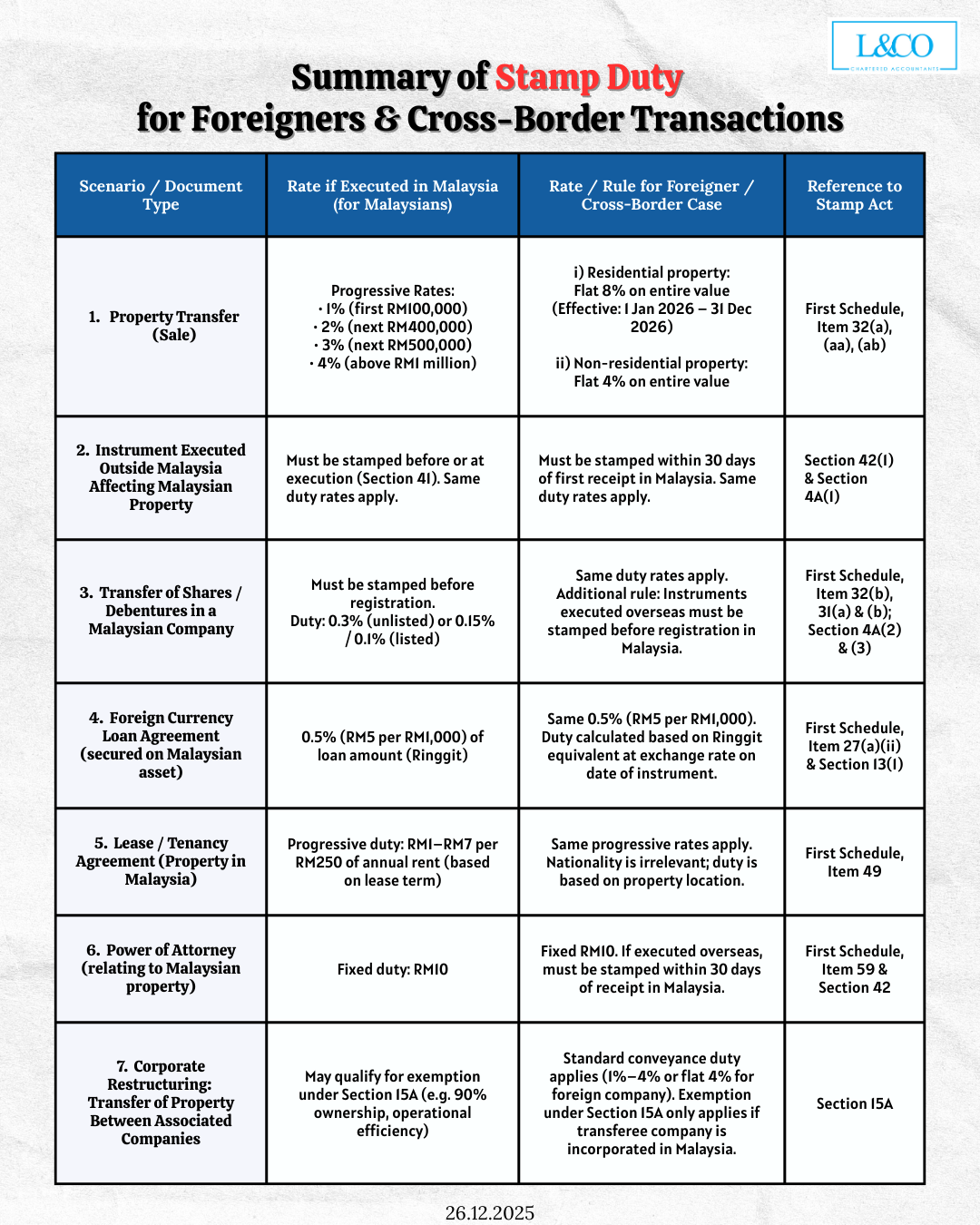
When dealing with foreign investments, cross-border transactions, or documents signed overseas,
the focus of stamp duty is not just on the rate itself. More importantly, it concerns:
whether the document is legally effective, compliant, and whether it may trigger penalties.
With regulations tightening in recent years, both companies and individuals must exercise extra caution in handling cross-border transactions.
Any document signed overseas but involving Malaysian assets or interests must be stamped before it acquires legal effect in Malaysia.
Consequences of unstamped documents:
- Cannot serve as legal evidence
- Cannot be used for registration or enforcement
- May render the transaction invalid
From 1 January 2026, penalties for overseas-signed but unstamped share transfer documents will increase:
From RM250 ➡ To RM1,000 – RM10,000
This will have a significant impact on cross-border investments and equity restructuring.
Permanent Residents (PR) are not considered foreigners
➡ Eligible for progressive stamp duty rates on local real estate
Foreigners
➡ Subject to fixed rates (e.g. 8% for residential property)
Incorrect residency determination may result in significant tax differences.
The stamping period for overseas-signed documents:
Starts from the date the document first enters Malaysia
Not the signing date
Recommended to keep:
- Courier records
- Email receipt timestamps
- Document delivery confirmations
These serve as compliance evidence.
Stamp duty must be calculated:
Using the exchange rate on the signing date
Not on the payment date
Not on the posting date
Cross-border transactions ≠ ordinary transactions
Overseas-signed documents ≠ can be delayed
Residency, timing, and exchange rate all impact tax outcomes
Errors in any step may result in:
- Increased penalties
- Document invalidity
- Transaction delays or rejection
**Data updated on 29/12/2025
 (201706002678 & AF 002133)