
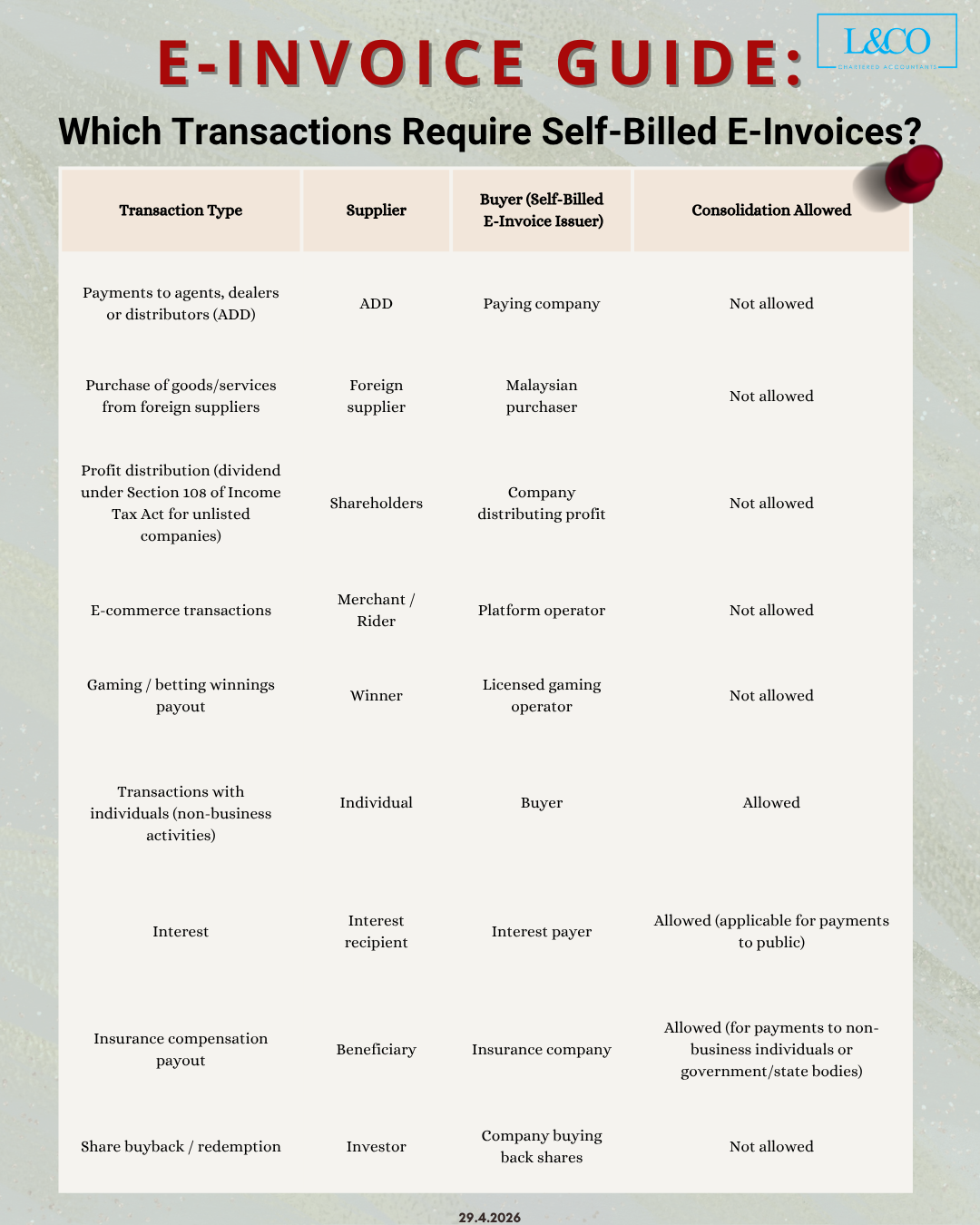
Under Malaysia’s E-Invoice framework, certain prescribed transaction types require the buyer to issue an e-Invoice on behalf of the supplier (Self-Billed E-Invoice). The following outlines the main applicable scenarios:
1. Mandatory Issuance (Consolidation Not Allowed)
The following transactions must be self-billed on a per-transaction basis and cannot be consolidated:
- Payments to agents, dealers, or distributors (ADD)
- Purchases of goods or services from foreign suppliers
- Distribution of dividends by non-listed companies (pursuant to Section 108 of the Income Tax Act)
- E-commerce transactions (issued by platform operators under applicable models)
- Payouts from gaming or betting activities
- Share buybacks or redemption of shares
2. Permitted Issuance (Consolidation Allowed Under Conditions)
The following transactions may be self-billed, and consolidation is allowed subject to conditions:
- Transactions with individuals not carrying on a business
- Interest payments to the general public
- Insurance claim payouts to individuals or government entities
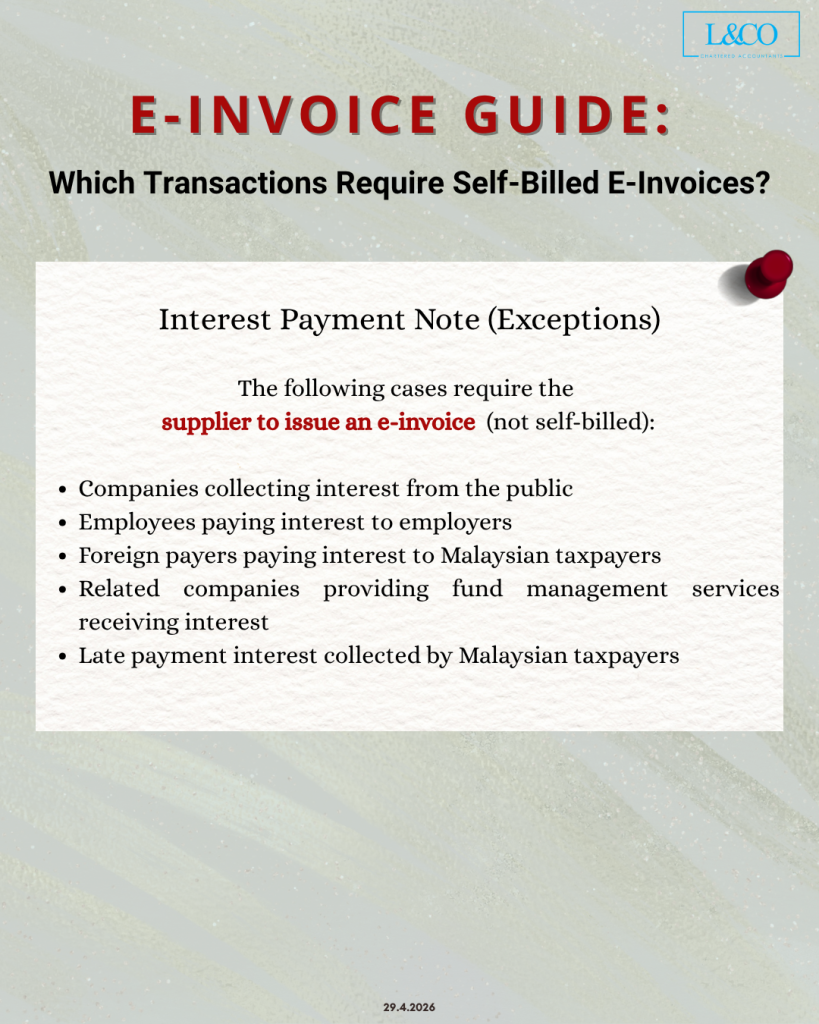
3. Exceptions for Interest Payments
For interest-related transactions, the following do not qualify for Self-Billed E-Invoice, and the supplier must issue the e-Invoice:
- Businesses providing loans to the public and earning interest
- Interest paid by employees to employers
- Interest paid by foreign payers to Malaysian taxpayers
- Interest paid to related companies providing treasury services
- Late payment interest imposed by Malaysian taxpayers
4. Summary
The core principle of Self-Billed E-Invoice is that it applies to prescribed scenarios where the buyer is required to issue the e-Invoice on behalf of the supplier.
However, not all similar transactions qualify. Businesses should assess the nature of each transaction carefully to ensure full compliance with E-Invoice requirements.
**Data updated on 30.4.2026
 (201706002678 & AF 002133)