

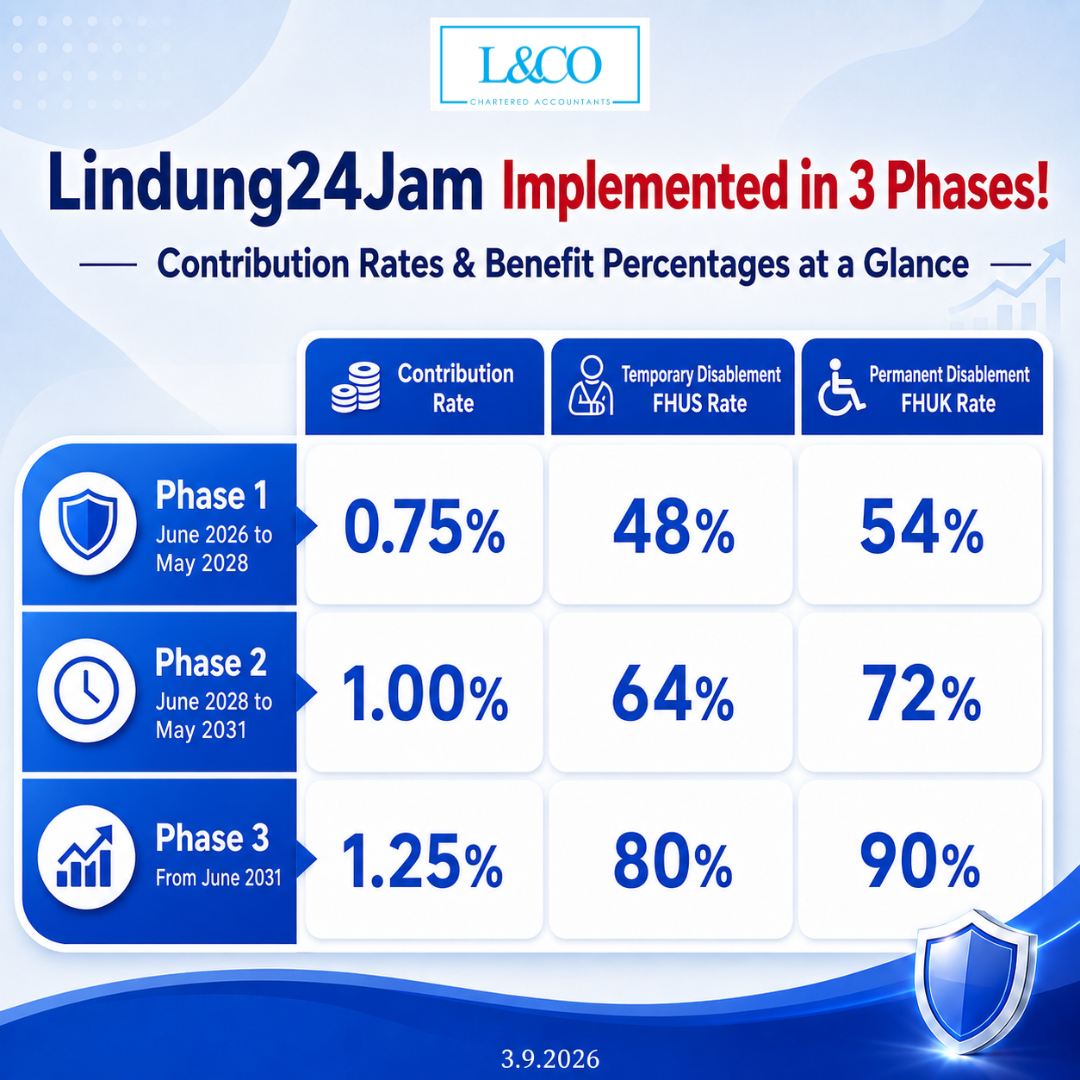
Lindung24Jam will be implemented progressively in three phases. In addition to changes in the contribution rate, the applicable rates for Temporary Disablement Benefit (FHUS) and Permanent Disablement Benefit (FHUK) will also increase over time.
Therefore, when understanding Lindung24Jam, employers and employees should not focus solely on contribution rates. It is equally important to understand how the level of protection and disability benefit calculations may differ across the various implementation phases.
How Is Temporary Disablement Benefit (FHUS) Calculated?
Temporary Disablement Benefit, or FHUS, generally relates to benefits payable when an insured person is temporarily unable to work due to a qualifying disablement.
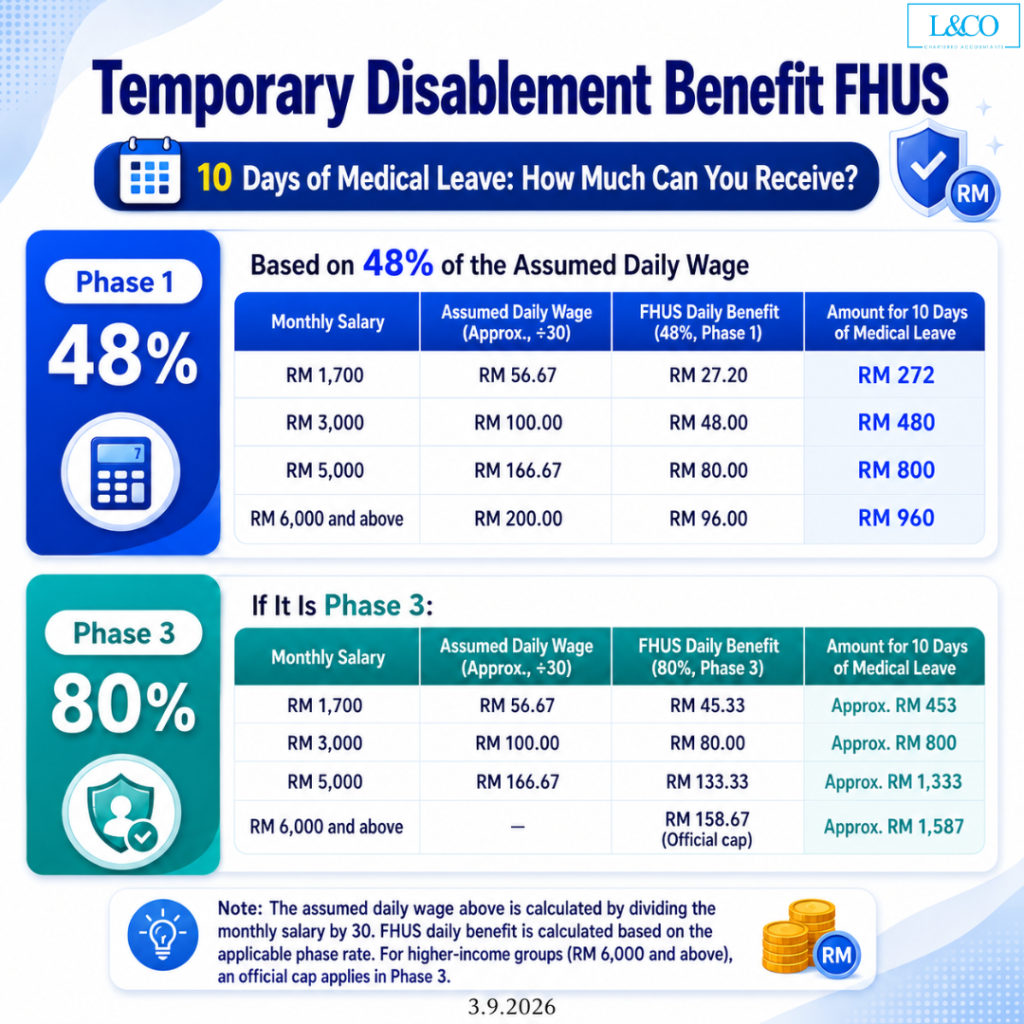
Using the illustration shown, for an employee earning RM3,000 per month and assuming 10 days of medical leave:
- Under Phase 1 (48%), the estimated FHUS for 10 days is approximately RM480.
- Under Phase 3 (80%), based on the same salary and number of leave days, the illustrated amount increases to approximately RM800.
This shows that as the FHUS rate increases from 48% to 80%, the temporary disablement benefit may also increase accordingly, assuming the other calculation factors remain unchanged.
For higher-income employees, applicable benefit ceilings may also affect the final amount. The actual benefit should therefore be determined based on the prevailing official limits and requirements.
How Is Permanent Disablement Benefit (FHUK) Different?
Permanent Disablement Benefit, or FHUK, may involve additional factors such as salary, assessed degree of permanent disablement, age-related factors and the applicable payment method.
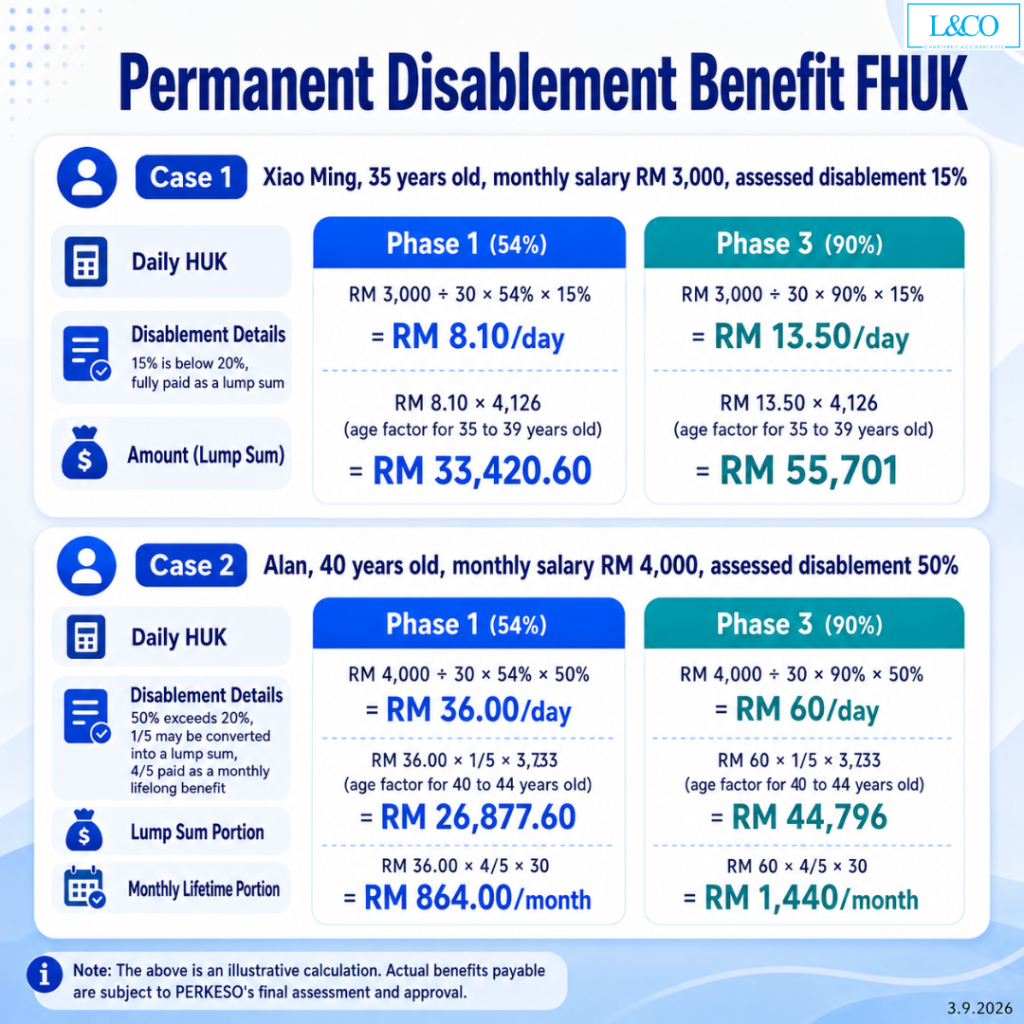
For example, based on an employee who is 35 years old, earns RM3,000 per month and is assessed with 15% permanent disablement:
Under the Phase 1 rate of 54%, the illustrated lump-sum amount is approximately RM33,420.60.
Under the Phase 3 rate of 90%, the illustrated amount increases to approximately RM55,701.
This demonstrates how the applicable FHUK rate under different implementation phases may have a significant impact on the final benefit amount.
What Happens When the Assessed Disablement Exceeds 20%?
Where the assessed permanent disablement is higher, the payment structure may not necessarily consist solely of a lump-sum payment.
Using another illustration, an employee who is 40 years old, earns RM4,000 per month and is assessed with 50% permanent disablement may receive benefits involving:
- A portion paid as a lump sum; and
- The remaining portion paid as a monthly benefit.
Based on the example shown, the daily HUK amount, lump-sum portion and monthly payment all differ between Phase 1 and Phase 3.
This means that the overall level of protection may increase as Lindung24Jam progresses through its implementation phases.
What Should Employers and Employees Take Note Of?
The key change under Lindung24Jam is not limited to the contribution rate increasing from 0.75% to 1.25%.
As each phase is implemented, the applicable FHUS and FHUK rates will also increase. Employers, HR teams and employees should therefore pay attention to the:
- Applicable implementation phase
- Contribution rate
- Temporary and permanent disablement benefit rates
Relevant calculation conditions and payment structure
Understanding these changes early can help employers prepare for payroll and HR-related matters while giving employees a clearer understanding of their social protection benefits.
Disclaimer:
The calculations above are for illustration and general information purposes only. Actual eligibility, disablement assessment, benefit amount and payment method are subject to the prevailing PERKESO rules, final assessment and official approval/payment.
 (201706002678 & AF 002133)