

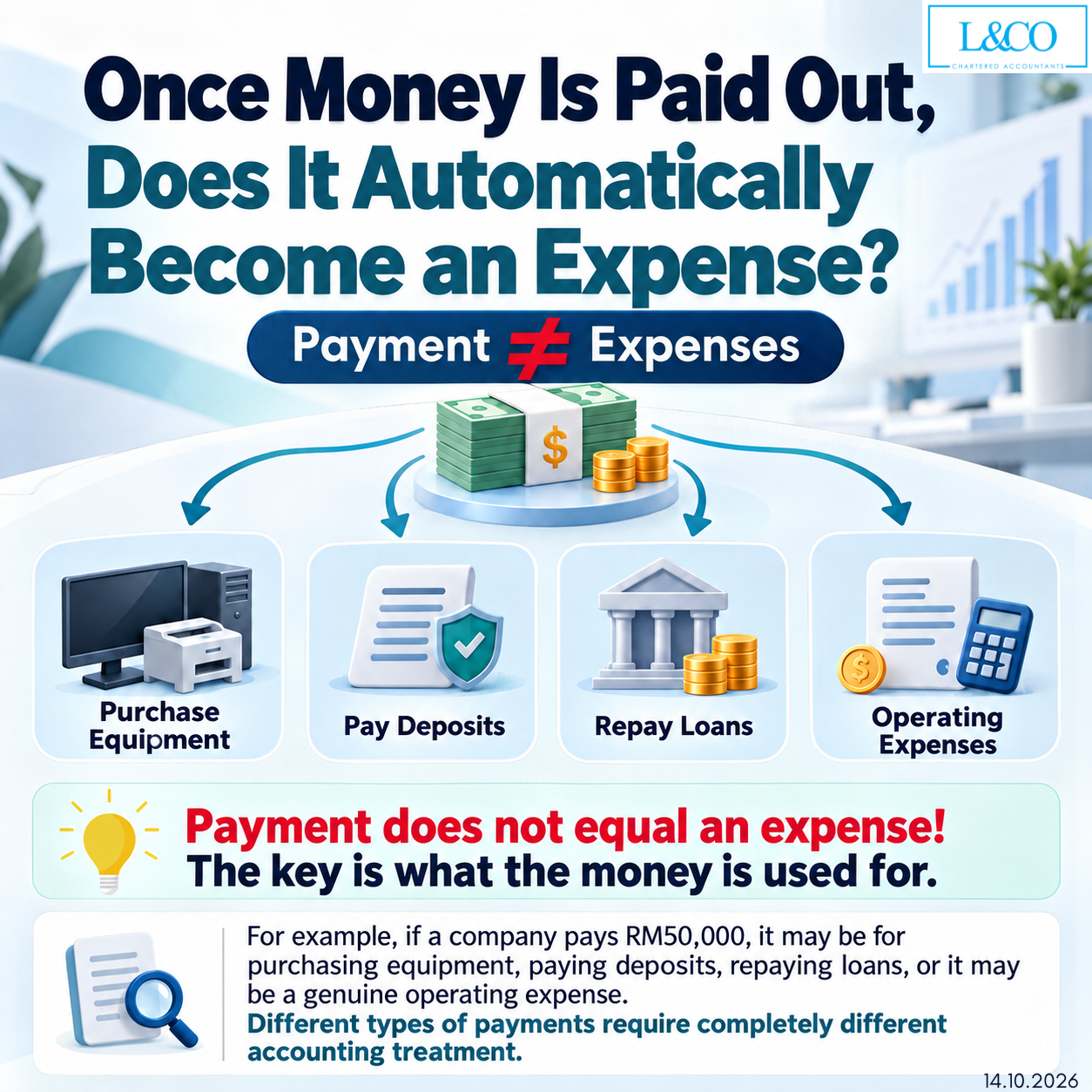
Businesses regularly make payments for rent, equipment, deposits, loans, directors’ transactions and other operational needs.
However, just because a company makes a payment does not necessarily mean the amount should be recorded as an expense.
Depending on the nature of the transaction and the applicable accounting standards, payments may need to be classified as operating expenses, fixed assets, prepayments, inventory, liability repayments or other accounting items.
Incorrect classification can affect the accuracy of financial statements, profit calculations and related tax treatments.
Therefore, before recording any transaction, businesses should identify the actual purpose and nature of the payment.
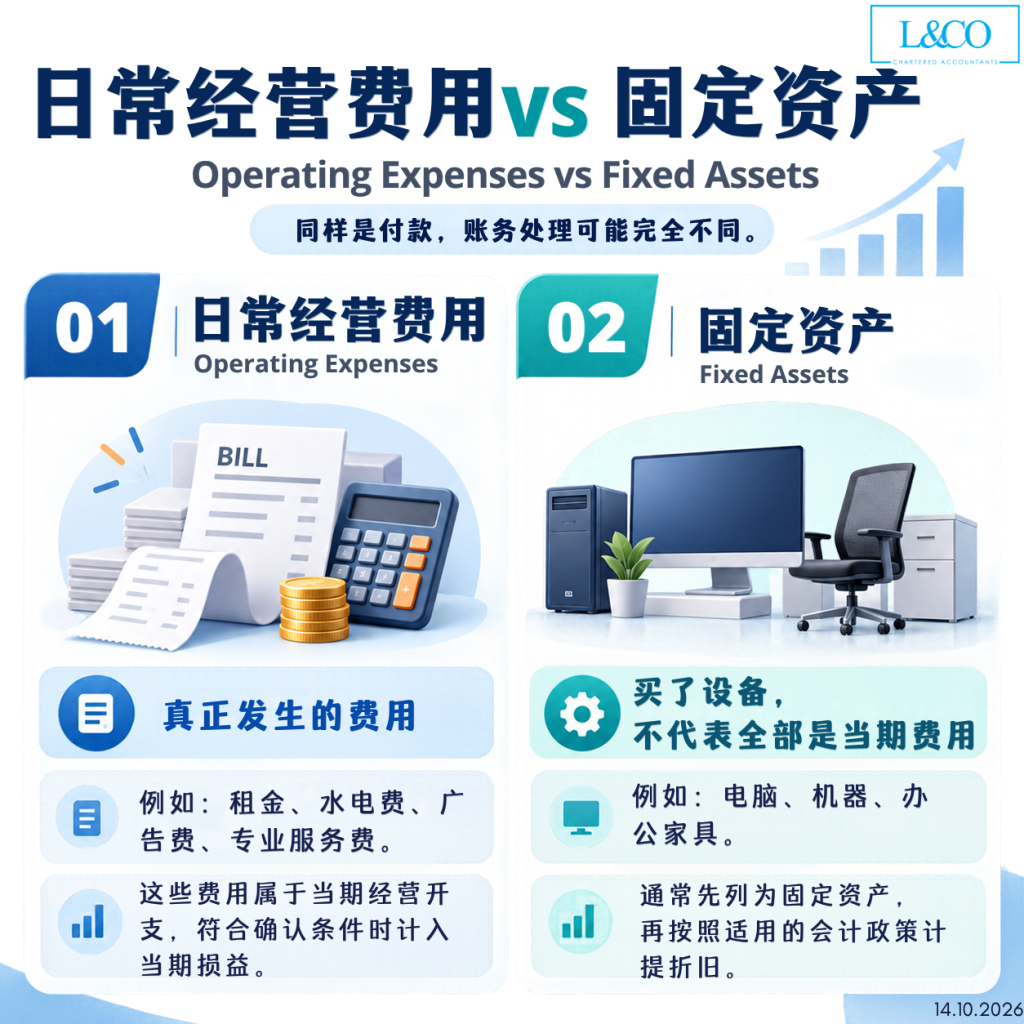
1. Understanding Operating Expenses vs Fixed Assets
Operating Expenses
Operating expenses are costs incurred in the ordinary course of business operations.
Common examples include:
- Office rental
- Utilities
- Advertising and marketing costs
- Professional service fees
When the relevant recognition criteria are met, these costs are generally recognised in profit or loss for the appropriate accounting period.
However, businesses must consider the nature and period of the expense rather than relying solely on the payment date.
Fixed Assets
When a business purchases computers, machinery, office furniture or other equipment intended for long-term use, the payment may not be fully recognised as an expense immediately.
If the asset recognition criteria are satisfied, the purchase is generally recorded as a fixed asset and depreciated over its estimated useful life in accordance with the applicable accounting policy.
Therefore, the accounting treatment for equipment purchases differs from ordinary operating expenses.
2. Eight Types of Payments That Are Not Always Expenses
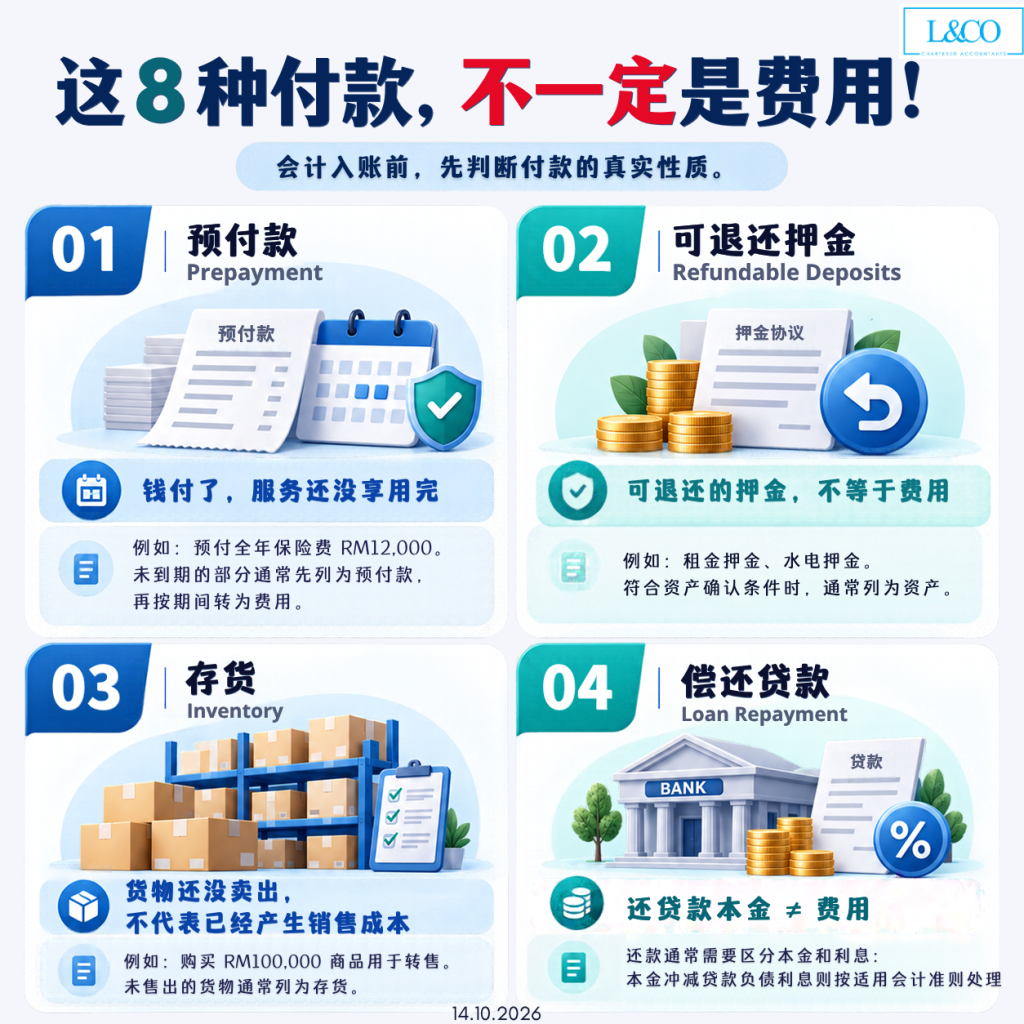
1.Prepayments
Making a payment does not mean the related service has been fully received.
For example, a company pays RM12,000 in advance for an annual insurance policy.
The unexpired portion is generally recorded as a prepayment and subsequently recognised as an expense over the relevant coverage period.
This ensures expenses are recognised in the appropriate accounting periods.
2.Refundable Deposits
Refundable deposits are generally not treated as expenses when paid.
Common examples include:
- Rental deposits
- Utility deposits
- Other refundable security deposits
Where the asset recognition criteria are satisfied, these amounts are generally recorded as assets in the statement of financial position.
Businesses should review contractual terms, refund conditions and the nature of the deposit to determine the appropriate accounting treatment.
3.Inventory
Purchasing goods does not automatically mean the cost of sales has been incurred.
For example, a company purchases RM100,000 worth of products for resale.
Goods that remain unsold are generally recorded as inventory rather than being immediately recognised in full as cost of sales.
The relevant costs are generally recognised as cost of sales when the goods are sold, subject to applicable inventory measurement and impairment requirements.
Proper inventory accounting helps businesses report gross profit and operating performance more accurately.
4.Loan Repayment
Repayment of loan principal is not an operating expense.
When a company repays a bank loan, the payment generally needs to be separated into:
- Principal: Reduces the outstanding loan liability.
- Interest: Accounted for in accordance with applicable accounting standards, including expense recognition or capitalisation where appropriate.
Therefore, the entire loan repayment should not automatically be recorded as an expense.
5.Director / Shareholder Payments
Payments made to directors or shareholders must be assessed based on their actual purpose.
Examples include:
- Director’s fees
- Expense reimbursements
- Director or shareholder loans
- Dividend distributions
- Director or shareholder withdrawals
Different transactions require different accounting treatments.
For example, qualifying director’s fees may be recognised as expenses, while dividend distributions are generally treated as distributions of equity rather than operating expenses.
Businesses should maintain appropriate approvals, payment records and supporting documentation.
6.Intercompany Payments
A payment from Company A to Company B does not necessarily represent an expense.
- Intercompany transactions may include:
- Intercompany loans
- Payments made on behalf of another company
- Purchases of goods
- Service charges
- Other related-party transactions
The accounting treatment should be determined based on the actual transaction, agreements and supporting documents.
For group companies, additional considerations may include related-party disclosures, consolidation adjustments and applicable tax requirements.
7.Capital / Project Costs
Certain business expenditures may qualify for capitalisation rather than immediate expense recognition.
Examples include:
- Qualifying construction costs
- Renovation and improvement costs
- Eligible software development costs
- Other qualifying project expenditures
Businesses should assess whether the expenditure meets the relevant asset recognition and capitalisation criteria under applicable accounting standards.
Where capitalisation is appropriate, the asset may subsequently be depreciated or amortised over the relevant period, depending on its nature.
8.Payment for Future Services
Paying for services in advance does not necessarily mean the entire amount can be recognised as an expense immediately.
For example, a company prepays service fees covering the next several months, such as software subscriptions, maintenance services or professional services.
The portion relating to services not yet received is generally recorded as a prepayment and recognised as an expense over the relevant service period.
This helps ensure expenses are recognised in the appropriate accounting periods.

Conclusion
Businesses make various payments throughout their operations, but not every payment should be immediately recorded as an expense.
What matters is not simply whether money has been paid, but what the payment is actually for.
Whether the transaction involves prepayments, refundable deposits, inventory, loan repayments, director or shareholder payments, or capital expenditure, proper accounting classification is essential.
Accurate accounting records help businesses maintain reliable financial statements, support sound financial planning and manage their tax obligations more effectively.
 (201706002678 & AF 002133)