
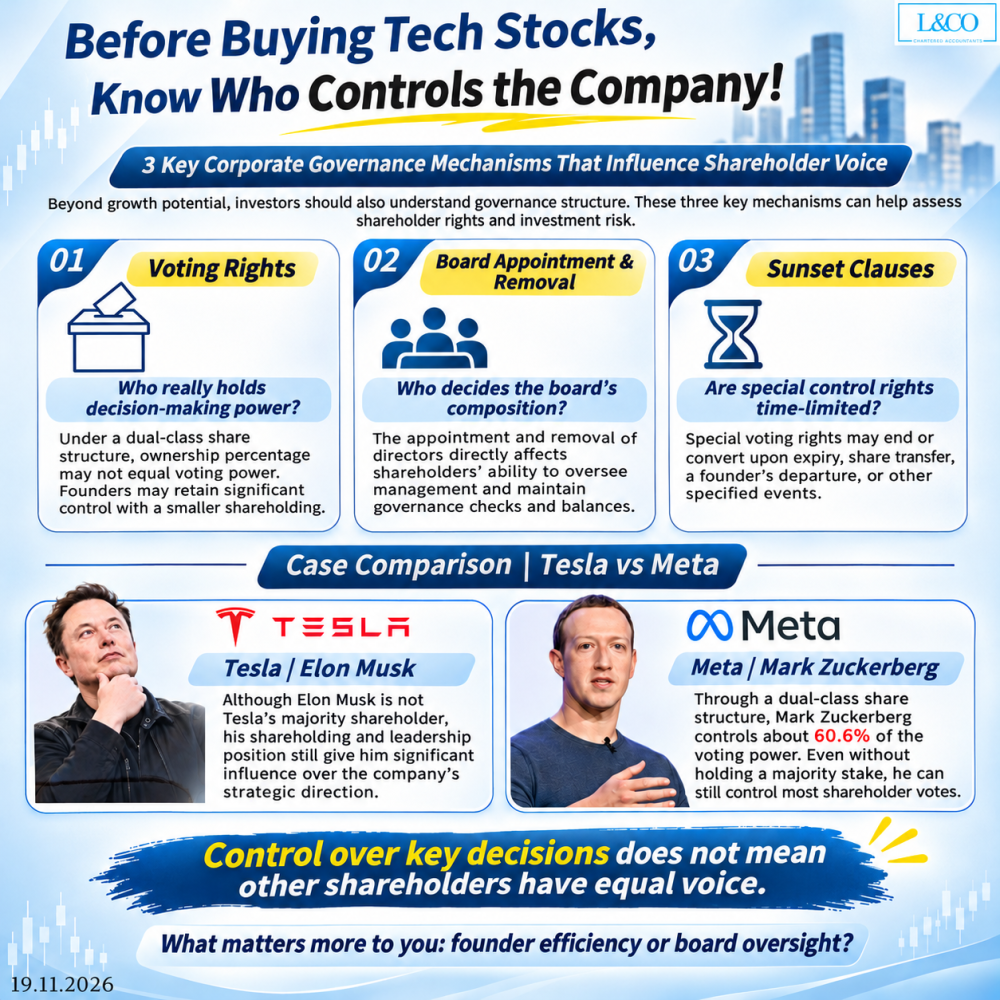
Three Key Corporate Governance Mechanisms That Influence Shareholder Rights: Tesla vs Meta
When investing in technology companies, investors often focus on profitability, share price performance, and future growth potential.
However, beyond financial performance, a company’s ownership structure and corporate governance mechanisms also deserve careful consideration.
Owning shares does not necessarily mean having an equivalent percentage of voting power.
Different corporate governance arrangements may give founders, major shareholders, and boards of directors varying levels of influence over important business decisions.
Understanding the following three mechanisms can help investors better assess shareholder rights, corporate control, and potential investment risks.
1. Voting Rights: Who Really Controls Corporate Decisions?
Voting rights allow shareholders to participate in important corporate decisions, including the election of directors and matters requiring shareholder approval.
Under the traditional One Share, One Vote principle, ordinary shares generally carry equal voting rights.
However, some technology companies adopt a Dual-Class Share Structure, where different classes of shares carry different voting powers.
Under such arrangements, founders may retain significant voting control despite holding a relatively smaller ownership stake.
Therefore, investors should examine not only ownership percentages but also the voting rights attached to different share classes.
2. Board Appointment & Removal: Who Determines the Board’s Composition?
The Board of Directors plays an essential role in overseeing management, reviewing major corporate decisions, and safeguarding the company’s long-term interests.
The appointment and removal of directors directly affect shareholders’ ability to oversee management and maintain effective checks and balances.
When voting power is concentrated among a small group of shareholders, those shareholders may exercise significant influence over board elections.
Conversely, an appropriate level of board independence and effective oversight mechanisms can strengthen corporate transparency and accountability.
Good corporate governance is not only about efficient decision-making but also about effective oversight and accountability.
3. Sunset Clauses: Are Special Control Rights Time-Limited?
Sunset clauses are provisions under which certain special rights expire or convert after a specified period or upon the occurrence of particular events.
In companies with special voting arrangements, triggering conditions may include:
- Expiration of a specified period;
- Departure of the company founder;
- Transfer of shares carrying special voting rights;
- Ownership falling below a predetermined threshold.
These provisions can help balance founders’ long-term control with the interests of other shareholders.
However, not all companies adopt sunset clauses. Their application depends on corporate constitutional documents, share terms, and applicable regulations.
4. Case Comparison: Tesla vs Meta
Although both Tesla and Meta are closely associated with their founders, the mechanisms through which their leaders exercise corporate influence are significantly different.
Tesla | Elon Musk: Influence Through Ownership and Leadership
Elon Musk is not Tesla’s majority shareholder. Nevertheless, his shareholding, position as a co-founder, and leadership role give him significant influence over the company’s strategic direction.
According to Tesla’s 2026 shareholder disclosures, Musk’s beneficial ownership represented approximately 19.8% as of September 30, 2026.
Tesla’s common stock generally follows the one-share, one-vote principle, rather than a typical founder-controlled dual-class voting structure.
This demonstrates that corporate influence is not determined solely by ownership percentages. Leadership responsibilities, shareholder support, and governance arrangements may also play important roles.
Meta | Mark Zuckerberg: Voting Control Through a Dual-Class Share Structure
Unlike Tesla, Meta operates under a dual-class share structure.
Its Class A common shares carry one vote per share, while Class B common shares carry ten votes per share.
According to Meta’s November 2026 disclosures, Mark Zuckerberg controlled approximately 60.6% of the company’s total voting power, despite holding approximately 13.4% of its total economic interests.
This arrangement allows Zuckerberg to exercise decisive influence over most shareholder voting matters without holding a majority of the company’s economic ownership.
Meta illustrates an important corporate governance principle:
Ownership percentage does not always equal voting power, and voting rights can significantly influence who controls a company.
5. Why Corporate Governance Matters to Investors
Corporate governance determines how major decisions are made, how management is held accountable, and how shareholders’ interests are protected.
Concentrated control may support long-term strategic consistency and efficient decision-making. However, it may also limit the ability of minority shareholders to challenge or oversee management decisions.
Therefore, when evaluating publicly listed companies, investors should consider more than revenue growth, profitability, and market valuation.
Important governance considerations include:
- Whether the company has special voting rights arrangements;
- Who exercises influence over board appointments and removals;
- Whether founders’ enhanced voting rights are subject to sunset provisions;
- How minority shareholder rights are protected.
These factors provide valuable insights into a company’s governance quality and potential long-term investment risks.