

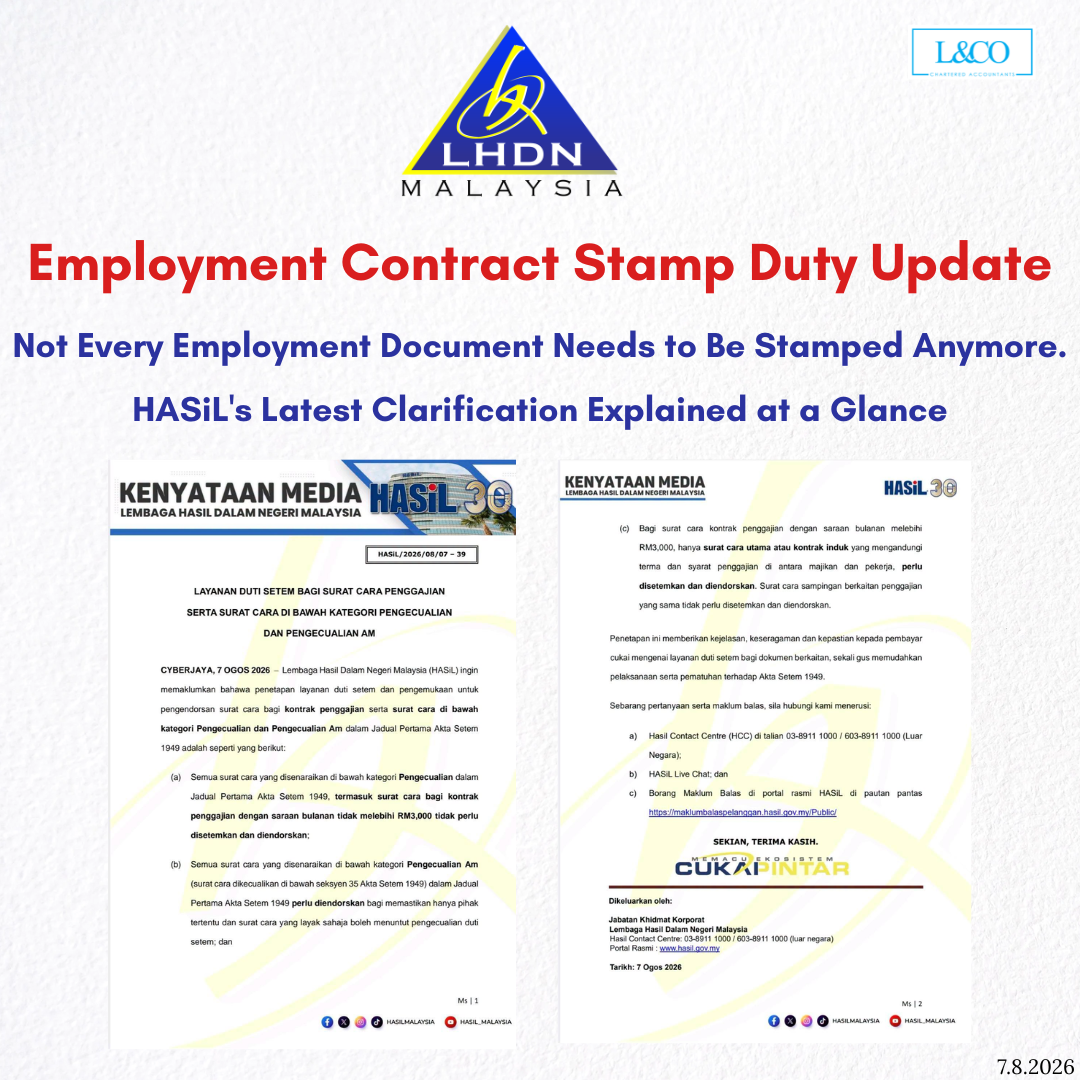
The Inland Revenue Board of Malaysia (HASiL) has issued a media statement dated 7 August 2026, providing further clarification on the Stamp Duty treatment for Employment Contracts.
The latest clarification explains which employment documents require Stamp Duty and endorsement, as well as which documents generally do not need to be stamped again. This update is particularly relevant to employers, HR professionals, payroll teams, and business owners who manage employment documentation.
Employment Contracts with a Monthly Salary of RM3,000 or Below
According to HASiL’s latest clarification, where an employee’s monthly salary does not exceed RM3,000:
- No Stamp Duty is payable.
- No endorsement is required.
In general, Employment Contracts within this salary threshold do not require Stamp Duty formalities.
Employment Contracts with a Monthly Salary Above RM3,000
For employees whose monthly salary exceeds RM3,000, employers generally only need to stamp and endorse one of the following documents:
- Main Employment Contract
- or Master Employment Contract
The required formalities include:
- Stamp Duty
- Endorsement
This means employers generally do not need to repeat the same process for every employment-related document under the same employment relationship.
Documents That Generally Do Not Require Restamping
HASiL further clarified that, for the same employment relationship, the following documents generally do not require a fresh Stamp Duty payment or endorsement:
- Salary Revision Letter
- Promotion Letter
- Addendum
- Variation Letter
- Allowance Letter
- Bonus Agreement
As a result, employers generally do not need to repeat the Stamp Duty process every time an employee receives a salary adjustment, promotion, or changes to employment terms, helping to simplify HR administration.
What Should Employers Do?
Although HASiL has provided clearer guidance, employers should continue to maintain proper employment documentation and ensure that the principal employment contract complies with the applicable Stamp Duty requirements.
For more complex employment arrangements or contracts with special terms, seeking professional tax or legal advice is recommended to ensure full compliance.
This article is prepared based on HASiL’s Media Statement dated 7 August 2026 and is intended for general informational purposes only. The actual Stamp Duty treatment depends on the specific facts, employment documents, and applicable laws. Employers should refer to the latest official guidance or seek professional advice where necessary.
****Data Updated on 07.08.2026
 (201706002678 & AF 002133)