

The Royal Malaysian Customs Department (RMCD) released the Rental & Leasing Services Guide (2nd Edition) on 14 May 2026, replacing the original 1st Edition issued on 9 June 2025.
The updated guide introduces several significant revisions affecting rental and leasing services, including changes to service tax rates, registration thresholds, residential accommodation exemptions, and practical tax treatments for various industry scenarios. Businesses involved in rental or leasing activities should review these updates to ensure compliance with the latest Service Tax (SST) requirements.
1. Service Tax Rate Adjustment
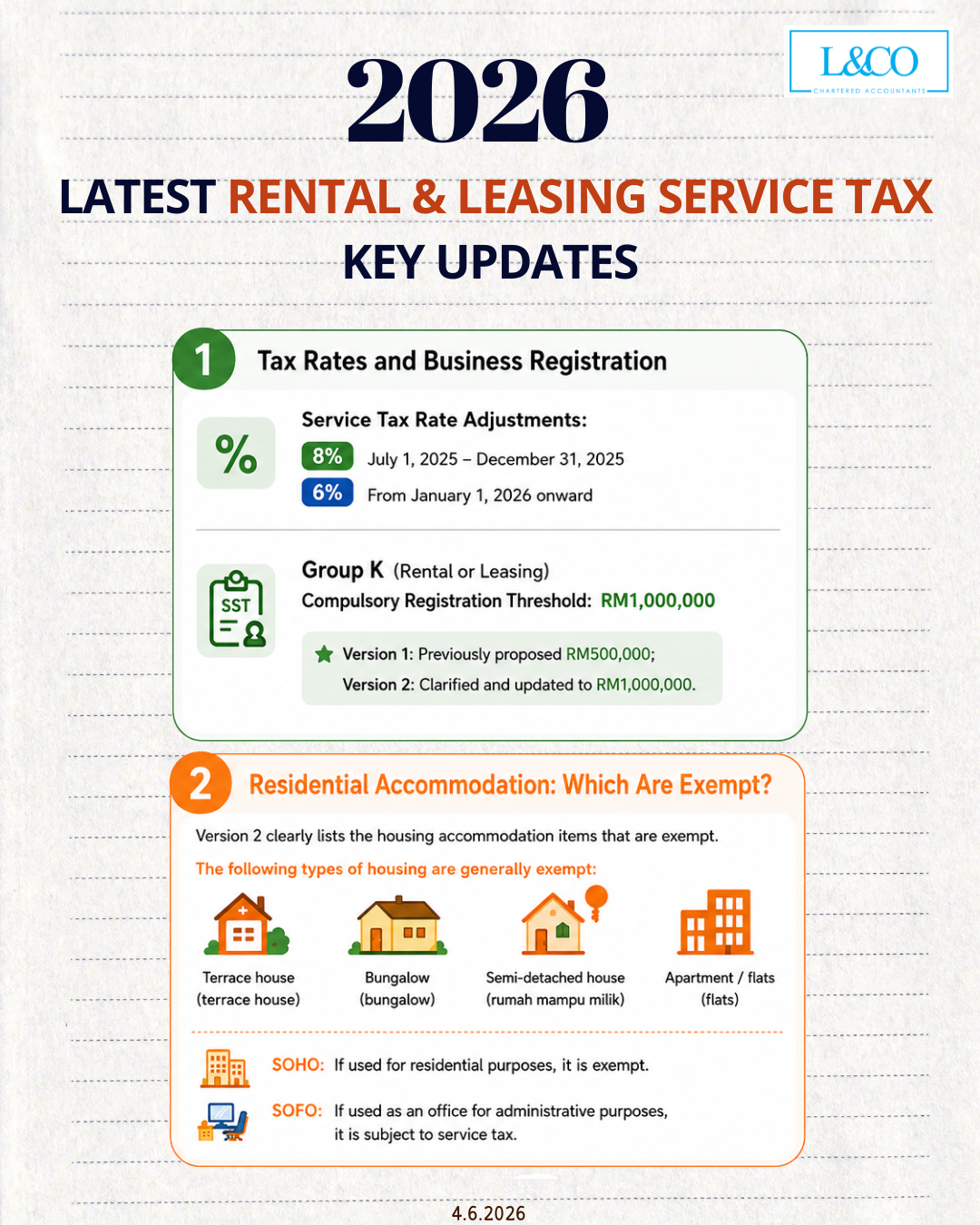
Under the 2nd Edition of the Guide, the applicable service tax rate for rental and leasing services has been revised as follows:
| Period | Service Tax Rate |
| 1 July 2025 – 31 December 2025 | 8% |
| From 1 January 2026 onwards | 6% |
2. Group K Registration Threshold Increased to RM1,000,000
The 2nd Edition and the related legislative amendments officially confirm that the mandatory registration threshold for:
Group K – Rental or Leasing Services
is now:
RM1,000,000
This supersedes the RM500,000 threshold previously referenced in the 1st Edition.
Businesses that provide taxable rental or leasing services and exceed, or are expected to exceed, RM1 million in taxable turnover over a 12-month period may be required to register for Service Tax.
3. Clearer Residential Accommodation Exemptions
The updated Guide provides a more detailed definition of Housing Accommodation, clarifying the types of residential properties that are not subject to Service Tax.
Generally, the following residential properties remain exempt:
- Terrace Houses
- Bungalows
- Apartments
- Flats
- Affordable Housing (Rumah Mampu Milik)
Tax Treatment of SOHO and SOFO
The Guide further clarifies:
SOHO (Small Office Home Office)
- Not subject to Service Tax when used for residential purposes.
SOFO (Small Office Flexible Office)
- Subject to Service Tax when used as an office or administrative premises.
As such, the actual use of the property is a key factor in determining taxability.
4. Practical Clarifications and New Industry Examples
The 2nd Edition significantly expands its practical guidance by introducing additional examples and clarifications for common business scenarios.
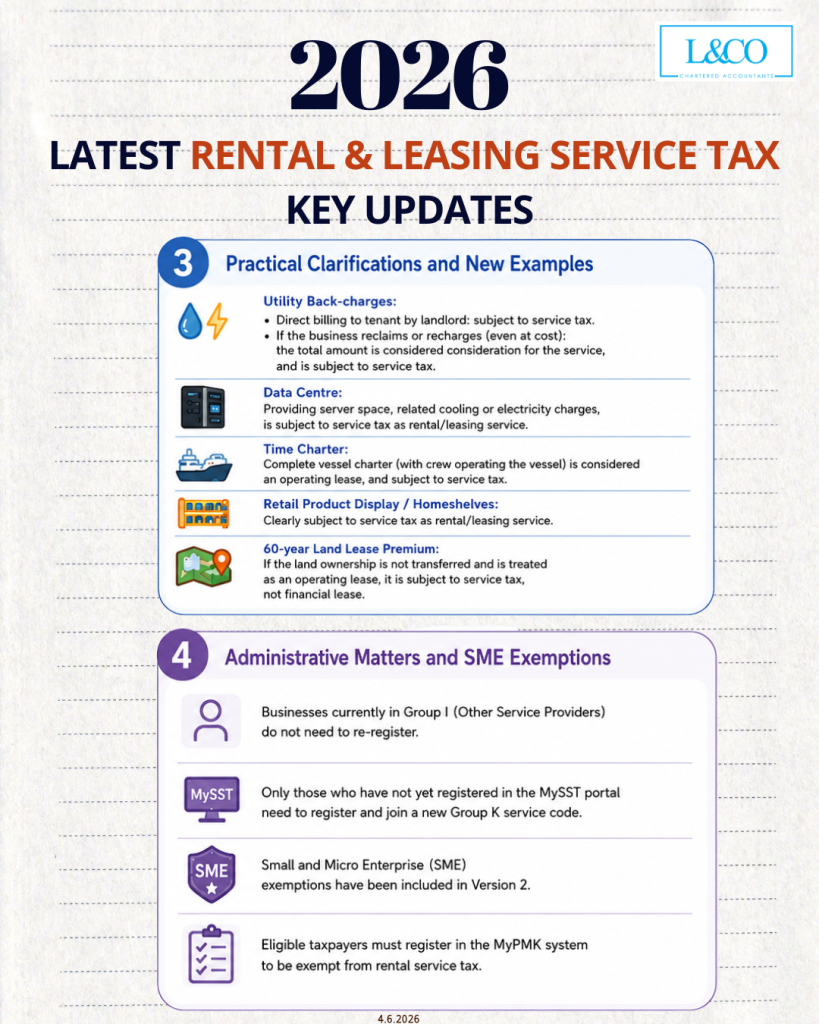
4.1 Utility Back-Charges
Where tenants pay utility charges directly to utility providers:
- No Service Tax applies.
However, where landlords recover or recharge utility expenses from tenants:
- Even if the charges are reimbursed at cost
- Even if no mark-up is imposed
The full amount recovered forms part of the rental service and is subject to Service Tax.
4.2 Data Centres
The provision of space for housing hardware and IT equipment within a data centre, including related charges such as:
- Rack space
- Server hosting space
- Cooling facilities
- Electricity supply
is treated as a taxable rental service and subject to Service Tax.
4.3 Time Charter Arrangements
Where a vessel is leased together with a full crew supplied by the owner, while operational control is exercised by the charterer:
The arrangement is classified as a taxable leasing service and is subject to Service Tax.
4.4 Product Display Space
Display racks, shelving space, and promotional product display areas provided within retail premises are now expressly recognised as taxable rental services.
4.5 Long-Term Land Leases
For a 60-year land lease arrangement where ownership of the land does not transfer to the lessee upon expiry of the lease:
The arrangement is treated as an:
Operating Lease
rather than a finance lease. Accordingly, the lease is subject to Service Tax.
5. Existing SST Registrants Are Not Required to Re-register
The Guide clarifies that businesses already registered under:
Group I – Other Service Providers
are not required to submit a new SST registration.
Instead, businesses only need to:
- Log in to the MySST Portal
- Update their registration details
- Add the relevant Group K service code
to comply with the new requirements.
6. SME Rental Service Tax Exemption Mechanism
The 2nd Edition formally incorporates the Small and Medium Enterprise (SME) Rental Service Tax Exemption Framework.
To qualify for the exemption, eligible tenants must:
Register through the MyPMK System
and fulfil the applicable requirements before enjoying the exemption from rental service tax.
Businesses should ensure that registration and application procedures are completed to avoid unnecessary tax exposure.
What Should Businesses Do Next?
With the implementation of the updated Rental & Leasing Services Guide, businesses involved in the following activities should review their SST obligations:
- Commercial property leasing
- Office rentals
- Factory rentals
- Warehouse leasing
- Land leasing
- Data centre services
- Vessel chartering and leasing
- Product display space rentals
Businesses are encouraged to reassess their turnover, leasing arrangements, taxability, and registration obligations to ensure full compliance with the latest SST regulations and minimise potential tax risks.
 (201706002678 & AF 002133)