

Information SharingSocial

Malaysian Employers: Failure to Report Job Vacancies May Result in a Fine of Up to RM1,000 for a First Offence

When recruiting new employees or creating new positions, Malaysian employers must pay attention not only to recruitment and onboarding processes but also to their legal obligation to report job vacancies.
According to the latest Employment Insurance System (Amendment) Bill 2025, employers who fail to report job vacancies as required may still be considered non-compliant. However, the previously proposed one-off high penalty has been revised and replaced with a tiered (progressive) penalty structure.
This means that the more frequently an employer commits the same offence, the higher the maximum penalty may be.


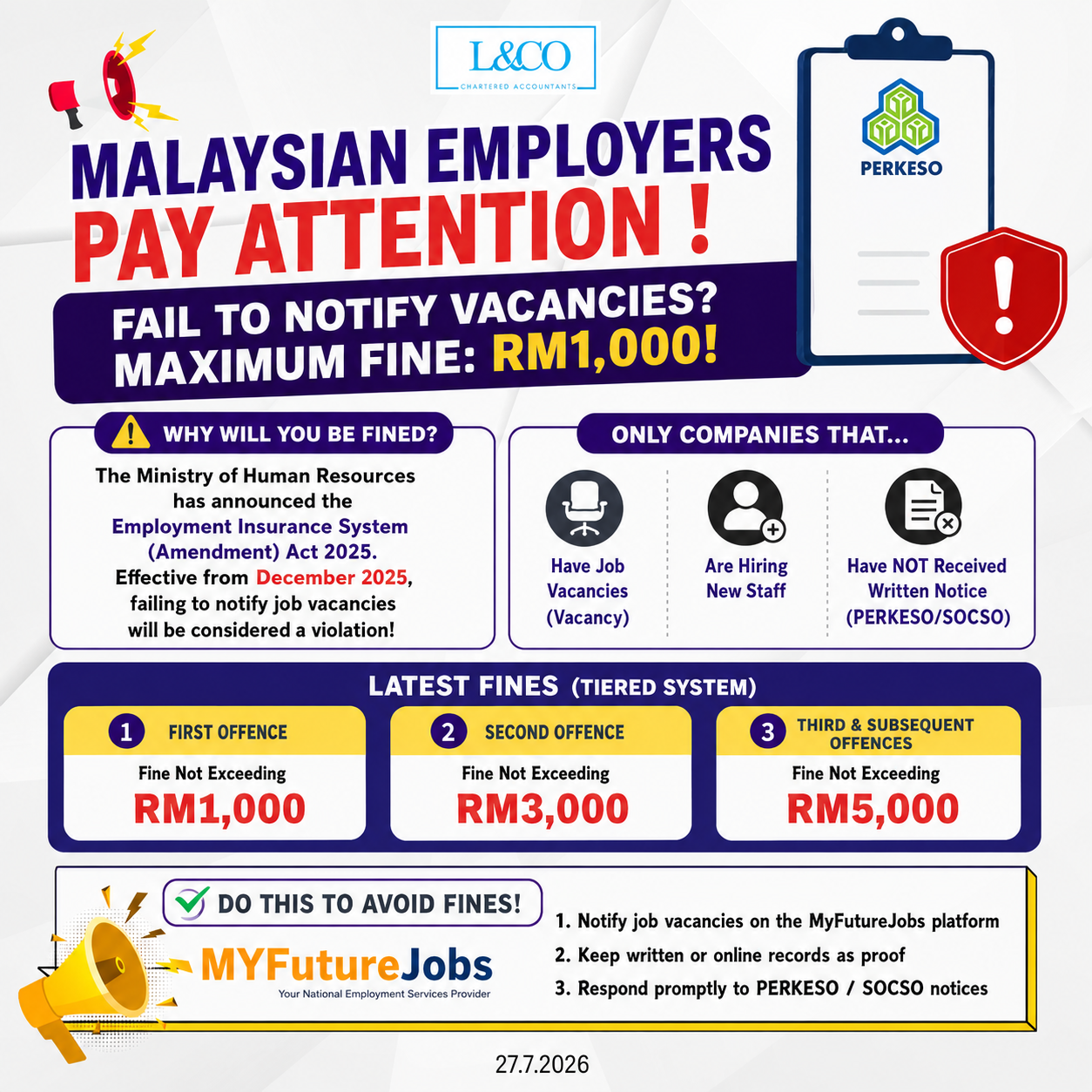
Under the proposed amendments, employers who fail to fulfil their job vacancy reporting obligations may face the following penalties:

Number of Offences Maximum Fine
First offence Up to RM1,000
Second offence Up to RM3,000
Third and subsequent offences Up to RM5,000

Compared to the previously discussed maximum penalty of RM10,000, the revised framework significantly reduces the penalty for first-time offenders, helping to ease the financial burden on businesses, particularly small and medium-sized enterprises (SMEs).

However, employers should note that a reduction in penalties does not mean the reporting obligation has been abolished.

Employers should pay particular attention when their company:

  • Has an existing job vacancy;
  • Creates a new position;
  • Is recruiting to fill an available position; or
  • Receives any notification or request from PERKESO or SOCSO regarding vacancy reporting.

If an employer has a job vacancy or creates a new position but fails to submit the required written or online notification to the relevant authority, the employer may be regarded as having failed to comply with the reporting requirement.

The purpose of the job vacancy reporting requirement is to enable the government to better understand labour market demand while helping job seekers connect with suitable employment opportunities.

By reporting job vacancies, the government can:

  • Monitor workforce demand across different industries;
  • Improve job matching between employers and local job seekers;
  • Strengthen labour market data management; and
  • Develop more targeted employment support initiatives.

Therefore, reporting job vacancies is not merely an administrative procedure—it is also an important part of labour market regulation and corporate compliance.

To minimise the risk of non-compliance, employers are encouraged to adopt the following practices:

1. Report Job Vacancies via the MYFutureJobs Platform
Whenever a job vacancy arises or a new position is created, employers should promptly submit the vacancy through the MYFutureJobs platform.

2. Maintain Proper Records
Keep copies of online submissions, written notifications, acknowledgement emails, and other supporting documents to demonstrate that the reporting obligation has been fulfilled.

3. Stay Updated with PERKESO and SOCSO Announcements
Employers and HR personnel should regularly monitor updates issued by PERKESO, SOCSO, and MYFutureJobs to ensure they are following the latest reporting requirements and procedures.

4. Establish an Internal Recruitment Compliance Process
Companies should incorporate vacancy reporting into their standard recruitment procedures. For example, once a new position is approved or a vacancy is identified, a designated person should be responsible for submitting the required report and maintaining proper documentation.

**Data updated on 28.7.2026
Leave a Reply