

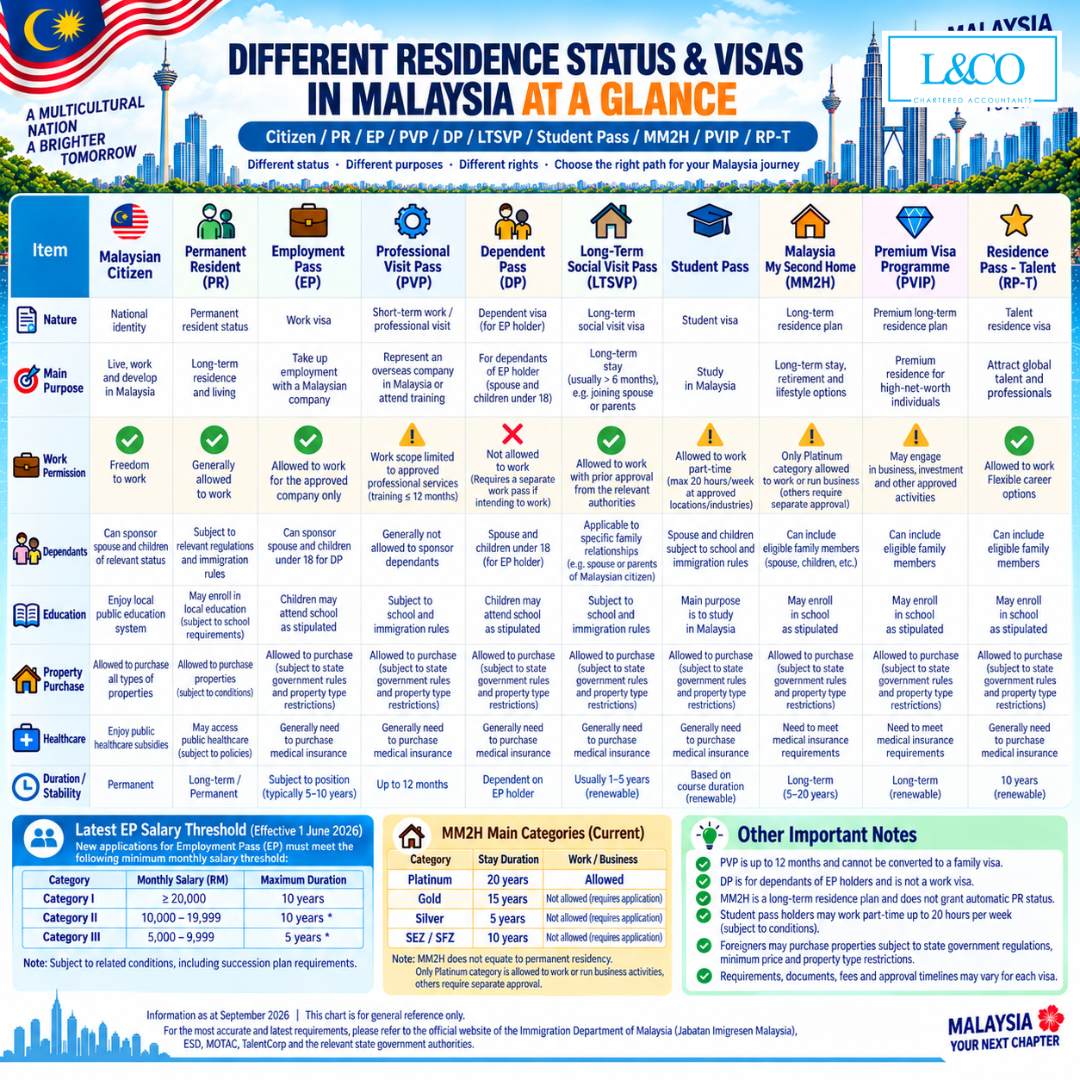
In recent years, Malaysia has become an increasingly popular destination for foreigners who wish to work, invest, study, or stay long-term. According to the Department of Statistics Malaysia (DOSM) 2025 International Migration Statistics, Malaysia had approximately 2.7 million non-citizens of working age, while the broader estimate covering various migrant categories was around 3.4 million.
However, staying in Malaysia legally is not simply about obtaining any visa or pass. Different residency statuses and passes come with different rules on length of stay, work rights, dependant eligibility, and business activities.
Below is a simple overview of the common residency statuses and passes in Malaysia.
1. Malaysian Citizen
A Malaysian citizen has the right to live, work, and carry out business activities freely in Malaysia.
2. Permanent Resident (PR)
Permanent Resident status allows an individual to reside in Malaysia on a long-term basis.
However, a PR holder is not the same as a Malaysian citizen.
3. Employment Pass (EP)
The Employment Pass is generally issued to foreign professionals, executives, managers, and expatriates who are employed by Malaysian companies.
In most cases, the EP is linked to the sponsoring employer, and the holder is only permitted to work in the approved role and under the approved employer.
Effective 1 June 2026, the EP salary thresholds have been revised:
| EP Category | Minimum Monthly Salary | Maximum Duration |
| Category I | RM20,000 | Up to 10 years |
| Category II | RM10,000 – RM19,999 | Up to 10 years* |
| Category III | RM5,000 – RM9,999 | Up to 5 years* |
*Subject to applicable requirements, including succession plan conditions where relevant.
4. Professional Visit Pass (PVP)
The Professional Visit Pass is generally for foreign professionals who are sent by an overseas company to Malaysia to provide professional services, technical support, or training.
The pass is generally valid for up to 12 months.
PVP holders are generally not eligible to apply for a Dependant Pass for their spouse or children.
5. Dependant Pass (DP)
The Dependant Pass is generally available to the eligible spouse and children below 18 years old of an Employment Pass holder.
It is important to note that a Dependant Pass does not automatically grant the right to work.
If the dependant wishes to work in Malaysia, a separate and appropriate work pass may be required.
6. Long Term Social Visit Pass (LTSVP)
The Long Term Social Visit Pass is commonly issued to the foreign spouse of a Malaysian citizen.
Where the relevant conditions are met and the required work endorsement is obtained from Immigration, the foreign spouse may work or carry out lawful business activities in Malaysia without converting to an Employment Pass.
7. Student Pass
The Student Pass is issued to eligible foreign students who wish to pursue their studies in Malaysia.
Subject to the relevant conditions, Student Pass holders may be allowed to take up limited part-time employment for up to 20 hours per week, and only in approved sectors or locations.
8. Malaysia My Second Home (MM2H)
The Malaysia My Second Home programme is intended for foreigners who wish to reside in Malaysia on a long-term basis.
The programme currently includes different categories such as:
- Platinum
- Gold
- Silver
- SEZ / SFZ
Each category comes with different conditions, residency periods, and work rights.
Based on the information provided:
- Platinum:20 years
- Gold:15 years
- Silver:5 years
- SEZ / SFZ:10 years
At present, only the Platinum Category allows employment and business or investment activities.
Holders under the other categories who wish to work or operate a business may need to apply for an appropriate work pass separately.
9. Premium Visa Programme (PVIP)
The Premium Visa Programme is a long-term residency programme aimed at eligible high-income individuals, investors, and professionals.
10. Residence Pass–Talent (RP-T)
The Residence Pass–Talent is intended for highly skilled foreign professionals.
Eligible individuals may be granted a stay of up to 10 years in Malaysia.
Having a Pass Does Not Automatically Mean You Can Work
This is one of the most important points to understand.
Different passes come with different work rights. For example:
- EP – work rights are generally tied to the approved employer and role
- PVP – generally limited to professional services or training activities
- DP – does not provide automatic work rights
- Student Pass – only allows restricted part-time work subject to conditions
- MM2H – work rights depend on the category held
Therefore, before applying for any pass, you should first determine whether your main purpose in Malaysia is to work, invest, study, carry out business, or reside long-term.
Can Foreigners Buy Any Property in Malaysia?
Not necessarily.
Foreigners who wish to purchase property in Malaysia should also consider:
- State government policies
- Minimum property purchase price
- Eligible property types
- Approval requirements and other restrictions
The rules may vary from one state to another. Therefore, holding a particular visa or pass does not automatically mean that a foreigner can purchase any type of property.
Choose the Right Status or Pass Based on Your Purpose
Malaysia offers different types of residency statuses and passes, and each comes with its own rights and restrictions.
If you are planning to come to Malaysia for:
- Employment
- Investment
- Business
- Education
- Long-term residence with family
it is important to understand the relevant eligibility requirements, work rights, dependant arrangements, and long-term implications before applying.
Choosing the right pass is not only about staying legally in Malaysia. It also affects whether you can work, run a business, bring your family, and remain in Malaysia long-term.
***Last updated on 09.09.2026
 (201706002678 & AF 002133)