

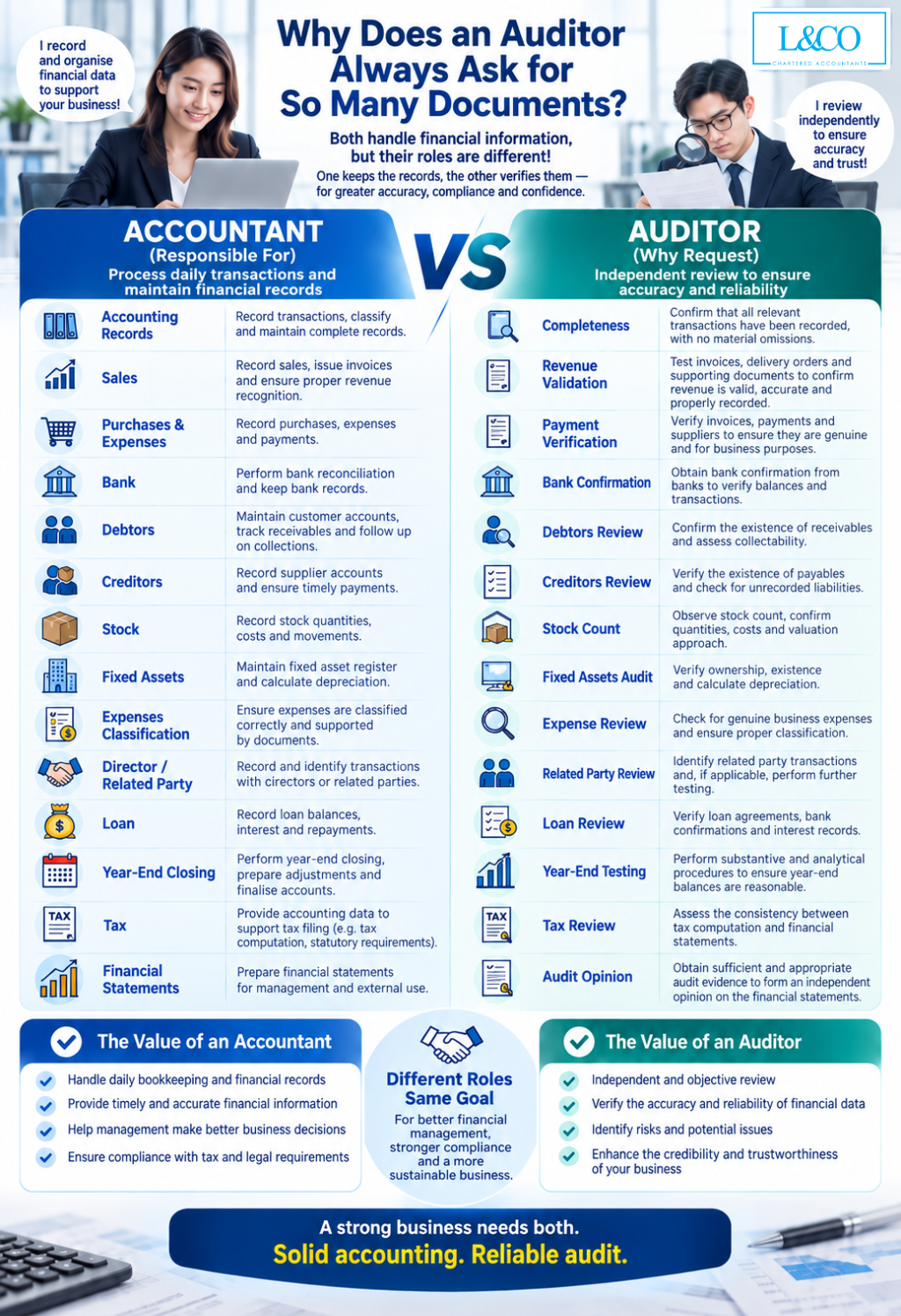
Many business owners and Accounting Teams have the same question:
“The accounts are already done — why does the Auditor still keep asking for documents?”
The reason is simple: Accountants and Auditors have different roles and responsibilities.
- An Accountant is mainly responsible for the day-to-day financial work, including recording transactions, organising documents, bank reconciliations, accounts receivable and payable, inventory, fixed assets, expense classification, year-end closing, and preparing Financial Statements.
- An Auditor, on the other hand, performs an independent review to examine, verify, and assess whether the financial information is properly supported and reliable.
So when an Auditor requests documents such as:
📄 Invoice / DO / Contract
🏦 Bank Statement & Confirmation
📦 Stock Count Records
💰 Payment Supporting
🤝 Related Party Documents
📊 Financial & Tax Information
it does not necessarily mean that your accounts are wrong.
In most cases, the Auditor needs to obtain sufficient appropriate audit evidence to verify whether the transactions are:
- Genuine and valid
- Completely recorded
- Accurately stated
- Recorded in the correct accounting period
- Supported by proper documentation
- Consistent with the figures reported in the Financial Statements
In simple terms:
Accountants prepare and organise the financial records.
Auditors independently verify whether those records and figures are accurate and reliable.
Their responsibilities may be different, but the goal is the same — to ensure the company’s financial information is accurate, compliant, transparent, and reliable.
So, the next time an Auditor requests supporting documents, understanding what they are trying to verify can help make the audit process smoother and more efficient.
Accountants build the foundation. Auditors verify the results. Together, they support the financial health of the business.
***Last updated on 11.09.2026
 (201706002678 & AF 002133)