
Following the increase of the e-Invoice exemption threshold to RM3 million, many Malaysian business owners have been asking the same questions:
If my annual turnover is below RM3 million, am I automatically exempt from e-Invoice?
If I have already started issuing e-Invoices, can I stop now?
What about Self-Billed e-Invoices and Consolidated e-Invoices?
HASiL updated its Implementation of e-Invoice in Malaysia – Frequently Asked Questions (FAQs) on 4 September 2026, providing further clarification on the RM3 million exemption, businesses that have already implemented e-Invoice, the Special Voluntary Disclosure Programme (SVDP), MSMEs and transitional arrangements.
Here are the key points businesses should know.
1. Annual Turnover Below RM3 Million — Are You Automatically Exempt from e-Invoice?
Not necessarily.
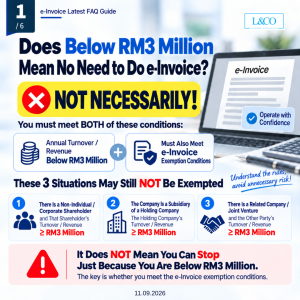
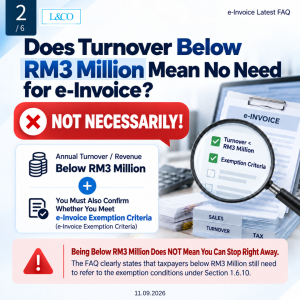
According to the latest FAQ, the e-Invoice exemption applies to various categories of taxpayers with annual turnover or revenue below RM3 million, including individuals, partnerships, companies, cooperatives and others.
However, having annual turnover or revenue below RM3 million does not automatically mean that a taxpayer qualifies for the exemption.
The exemption does not apply where the taxpayer falls under any of the following circumstances:
- The taxpayer has a non-individual shareholder (or equivalent) with annual turnover or revenue of at least RM3 million;
- The taxpayer is a subsidiary of a holding company with annual turnover or revenue of at least RM3 million; or以上;
- The taxpayer has a related company or joint venture with annual turnover or revenue of at least RM3 million.
Therefore, businesses should not look only at their own annual turnover or revenue.
The company’s shareholding structure, holding company relationship and related companies or joint ventures should also be reviewed before determining whether the e-Invoice exemption applies.
2. Already Started Issuing e-Invoices — Can You Stop If You Now Qualify for the RM3 Million Exemption?
YES。
This is one of the most important clarifications in the latest FAQ.
The FAQ provides the example of Raj’s company, which has annual turnover or revenue below RM3 million and meets the relevant e-Invoice exemption criteria. Although the company had already started issuing e-Invoices from 1 July 2026, HASiL clarified that:
No separate application or prior approval from IRBM is required, and the company may discontinue issuing e-Invoices immediately.
The same treatment applies in the example involving Siti. Where the business has annual turnover or revenue below RM3 million and meets the exemption criteria, it may discontinue issuing e-Invoices even though it had already started implementation.
In simple terms:
Having already implemented e-Invoice does not necessarily mean you must continue issuing e-Invoices.
The key question is whether the business currently qualifies for the exemption.
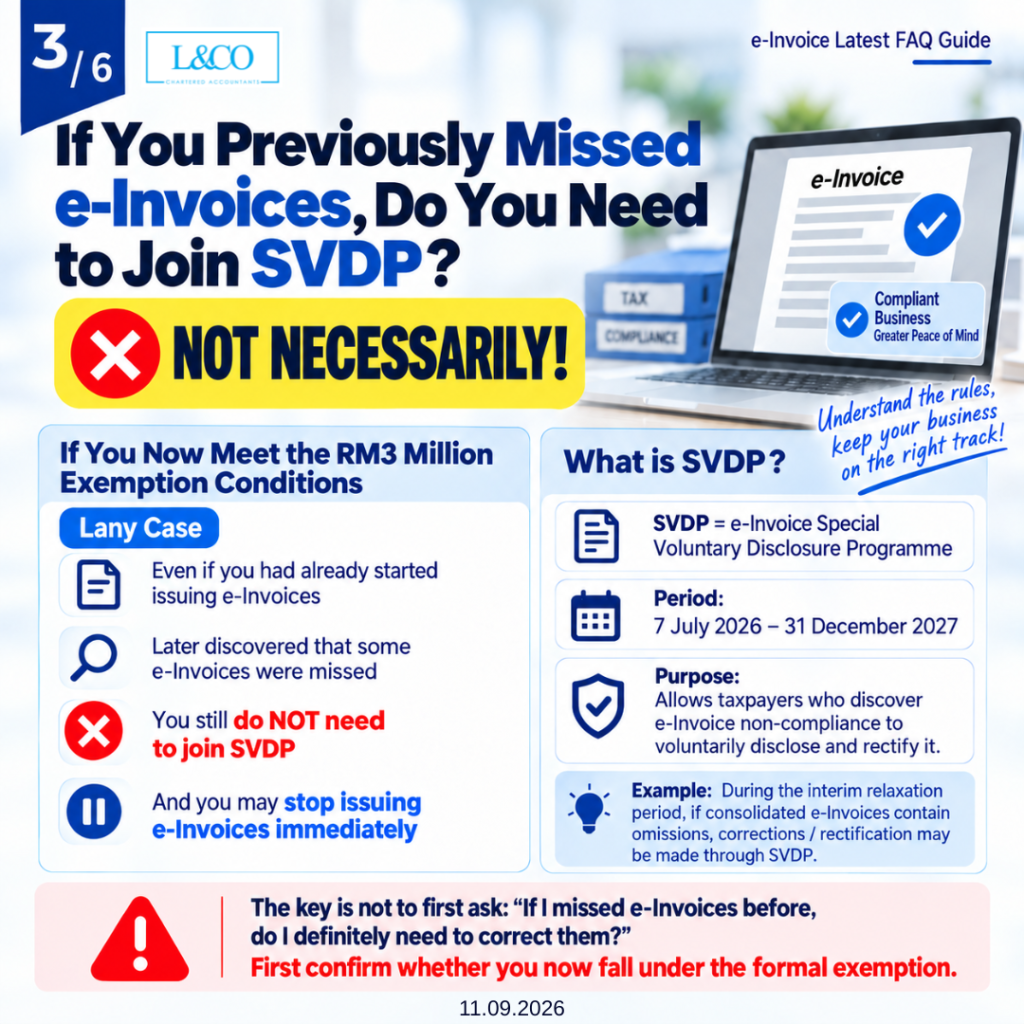
3. If You Previously Omitted Some e-Invoices, Must You Participate in the SVDP?
Not necessarily.
The FAQ provides an example involving Lany’s company.
The company had already started issuing e-Invoices but subsequently discovered that certain e-Invoices had not been issued.
However, because the company has annual turnover or revenue below RM3 million and meets the relevant exemption criteria, HASiL clarified that:
- The company is not required to participate in the e-Invoice Special Voluntary Disclosure Programme (SVDP) for those omitted e-Invoices and may discontinue issuing e-Invoices immediately.
Therefore, when a business discovers previously omitted e-Invoices, it should not automatically assume that participation in the SVDP is required.
The first step should be to determine whether the business currently qualifies for the e-Invoice exemption.
What Is the e-Invoice SVDP?
The e-Invoice Special Voluntary Disclosure Programme (SVDP) was introduced to facilitate taxpayers in regularising their e-Invoice compliance and voluntarily disclosing identified e-Invoice non-compliance
According to the FAQ, the SVDP runs from:
- 7 July 2026 to 31 December 2027
Taxpayers intending to participate should ensure that the relevant voluntary disclosure is submitted within the programme period.
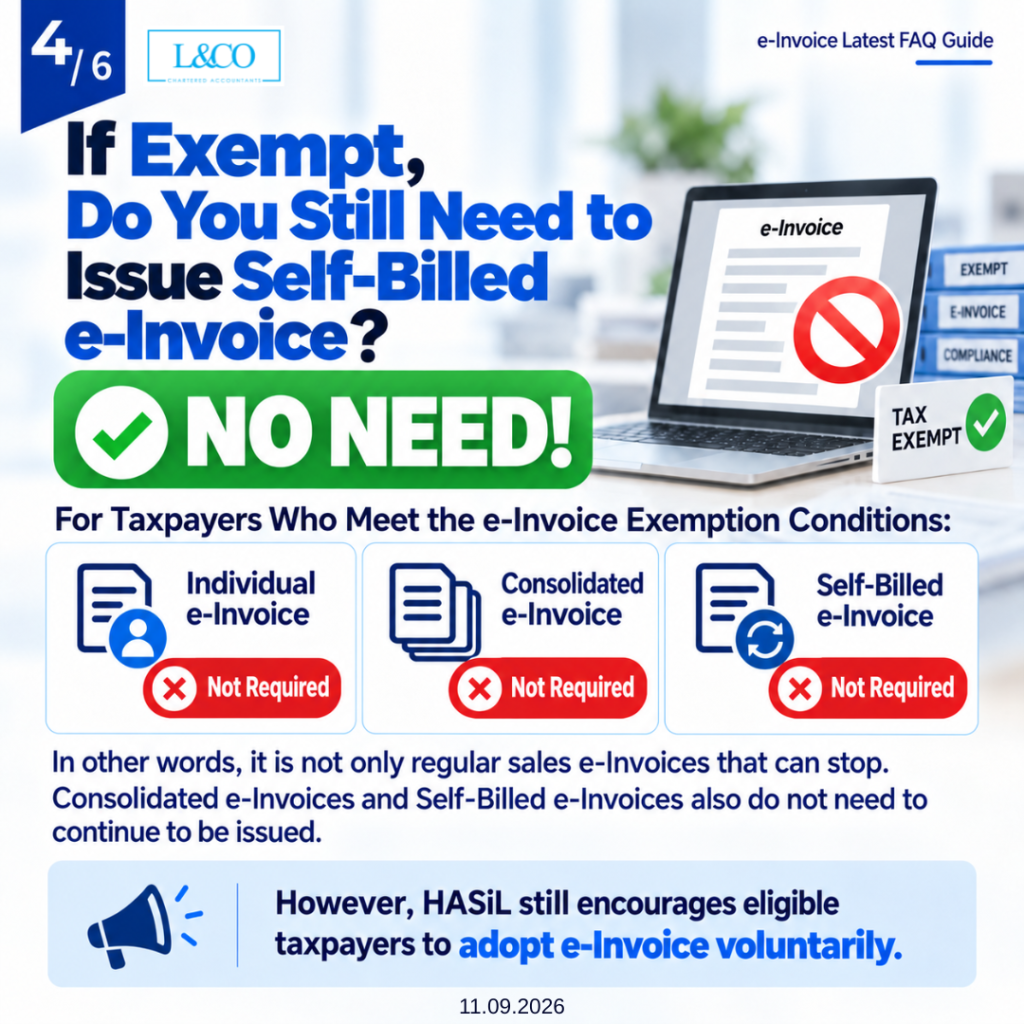
4. If You Are Exempt, Do You Still Need to Issue Self-Billed or Consolidated e-Invoices?
No。
The FAQ also provides clarification on this point.
Eligible taxpayers who are exempt from e-Invoice implementation are not required to issue Consolidated e-Invoices or Self-Billed e-Invoices.
In simple terms, if you officially qualify for the e-Invoice exemption:
Individual e-Invoice → Not required
Consolidated e-Invoice → Not required
Self-Billed e-Invoice → Not required
However, HASiL continues to encourage exempted taxpayers to adopt e-Invoice on a voluntary basis.
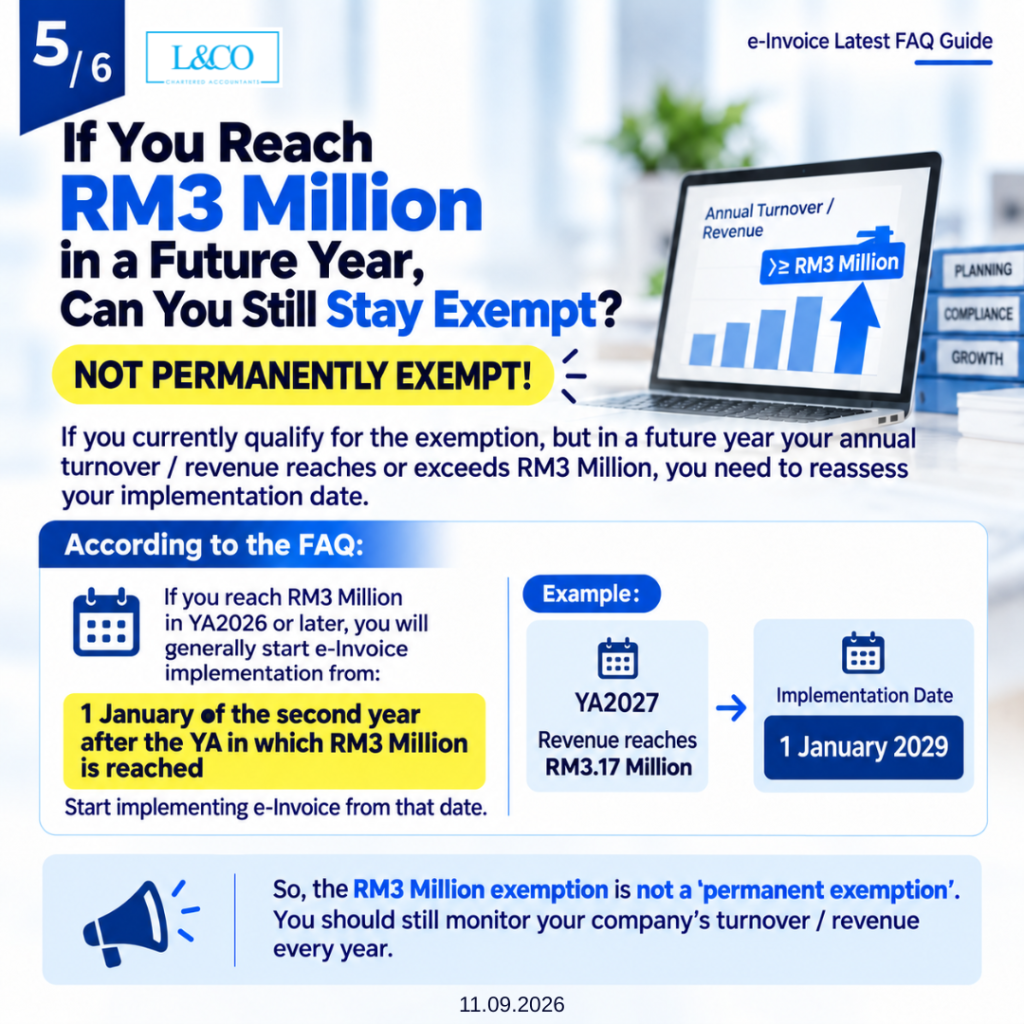
5. What Happens If Your Annual Turnover or Revenue Exceeds RM3 Million in the Future?
The RM3 million exemption is not a permanent exemption.
If a taxpayer currently qualifies for the exemption but subsequently reaches or exceeds RM3 million in annual turnover or revenue, the taxpayer will need to reassess its e-Invoice implementation date.
For qualifying taxpayers whose annual turnover or revenue reaches or exceeds RM3 million in YA2026 or thereafter, the FAQ generally provides that e-Invoice implementation will begin on:
- 1 January in the second year following the YA in which annual turnover or revenue reaches or exceeds RM3 million.
Example:
If a business records: YA2027:Annual Revenue = RM3.17 Million
Its e-Invoice implementation date would be: 1 January 2029
Businesses that are currently exempt should therefore continue monitoring their annual turnover or revenue each year to ensure that they do not miss their future mandatory implementation date.
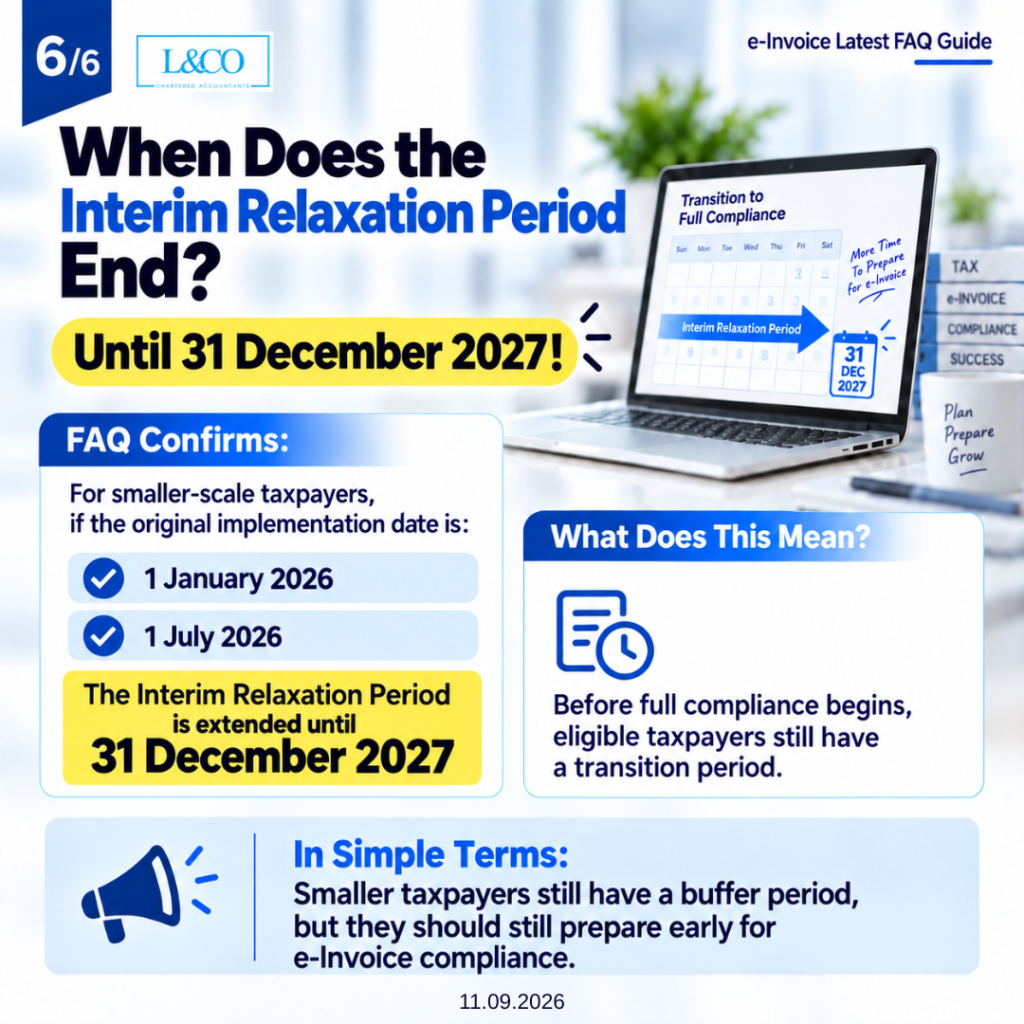
6. When Does the Interim Relaxation Period End?
The latest FAQ also confirms the Interim Relaxation Period applicable to certain smaller taxpayers.
For taxpayers whose original e-Invoice implementation date falls on: 1 January 2026 or 1 July 2026
the Interim Relaxation Period extends until::31 December 2027
This provides a transitional arrangement before full compliance with the applicable e-Invoice requirements.
Businesses should nevertheless use this period to review their invoicing processes, accounting systems and relevant business information to prepare for e-Invoice compliance.
This article is based on HASiL’s “Implementation of e-Invoice in Malaysia – Frequently Asked Questions (FAQs)”, updated on 4 September 2026, and is intended for general information purposes only.
 (201706002678 & AF 002133)