
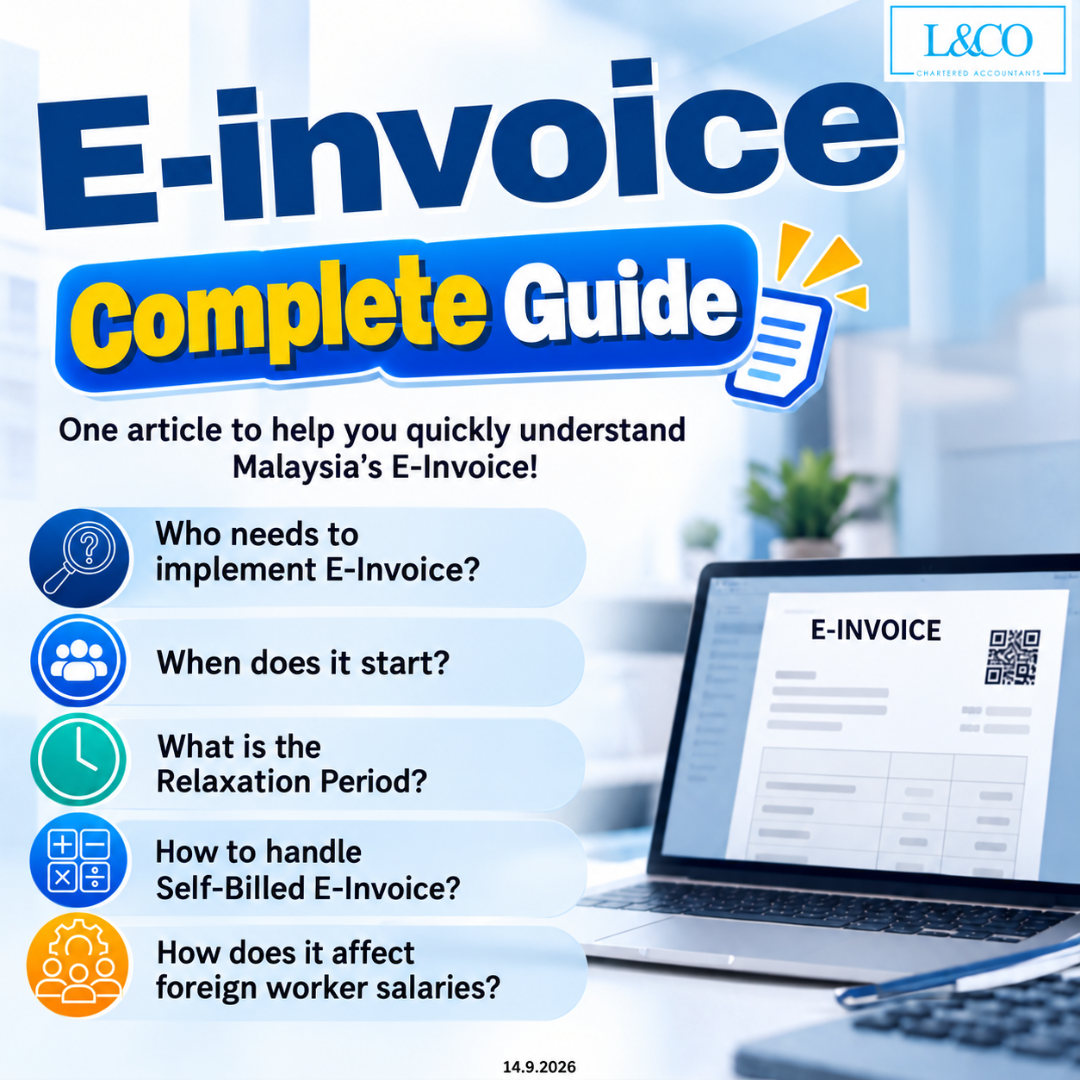
Malaysia’s E-Invoice requirements have gone through several updates, with changes involving implementation timelines, exemption criteria and compliance arrangements.
For many business owners, Accounting Teams and Finance Teams, the challenge is no longer simply understanding what an E-Invoice is. The real questions are:
When do we need to implement E-Invoice? Are we eligible for exemption? What happens if our turnover changes? Do we need Self-Billed E-Invoices? Can we issue Consolidated E-Invoices?
To make things easier, we have compiled this E-Invoice Ultimate Guide covering some of the most common questions businesses need to understand.
1. What Exactly Is an E-Invoice?
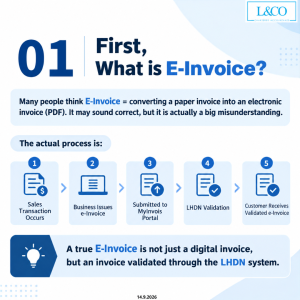
An E-Invoice is not simply a normal invoice converted into PDF format and sent to a customer by email.
An E-Invoice involves structured transaction data that is submitted to IRBM/LHDN’s MyInvois system for validation.
The general process involves generating the E-Invoice, submitting the relevant information to MyInvois, obtaining validation and subsequently providing the validated E-Invoice to the buyer.
Therefore:
Digital Invoice / PDF Invoice ≠ Validated E-Invoice
2. Who Needs to Implement E-Invoice and When?
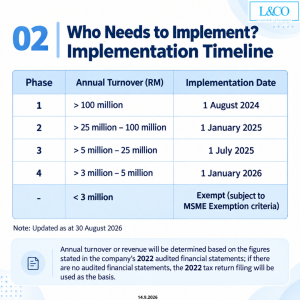
A taxpayer’s E-Invoice implementation date may depend on factors such as its Annual Turnover or Revenue, incorporation or commencement date, and the applicable implementation rules.
Different categories of taxpayers may therefore have different implementation dates.
At the same time, certain smaller businesses may qualify for an E-Invoice exemption if they meet the relevant criteria.
This means businesses should not determine their E-Invoice obligations based solely on their turnover.
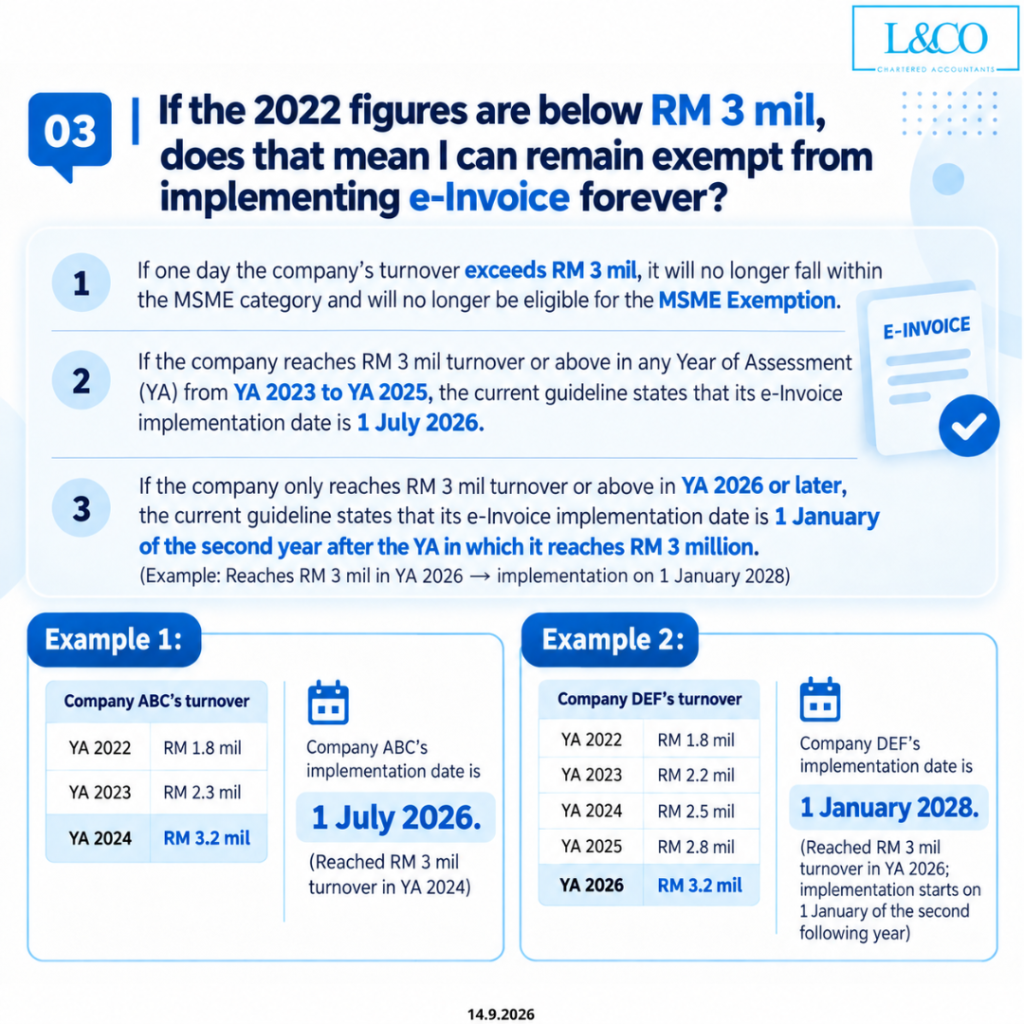
3.If My 2022 Turnover Was Below RM3 Million, Am I Permanently Exempt?
Not necessarily.
Historical turnover may be relevant in determining a taxpayer’s initial implementation phase, but subsequent changes in Annual Turnover or Revenue may also affect the taxpayer’s E-Invoice obligations.
If the business reaches the applicable turnover threshold in a subsequent Year of Assessment (YA), its implementation timeline may need to be reassessed according to the applicable rules.
In other words, businesses should continue monitoring their turnover instead of assuming that an earlier exemption will automatically continue indefinitely.
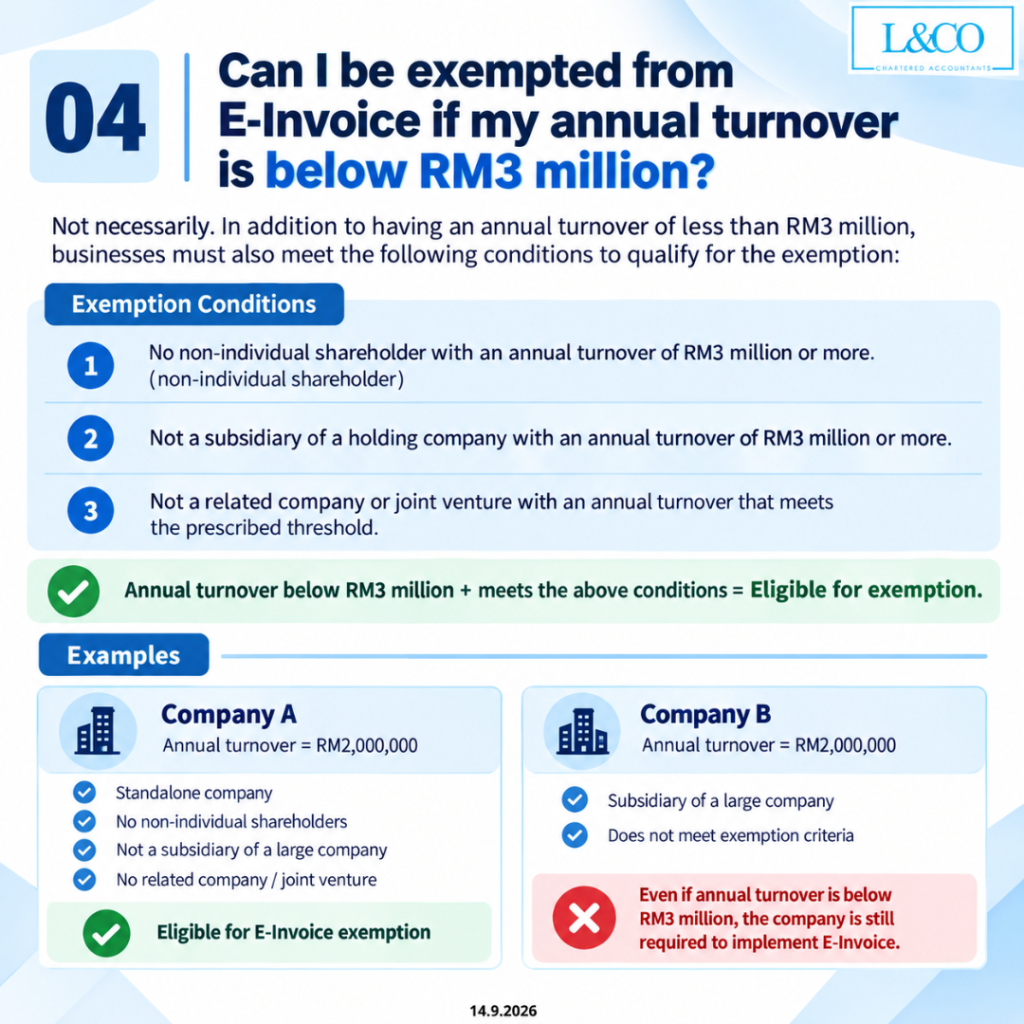
4. Does Turnover Below RM3 Million Automatically Mean E-Invoice Exemption?
This is one of the most common misunderstandings.
Having Annual Turnover or Revenue below RM3 million does not necessarily mean that a taxpayer is automatically exempt from E-Invoice.
Businesses must also review the applicable exemption criteria, including factors relating to their corporate and ownership structure.
This may include whether the business has certain non-individual shareholders or equivalent parties, or whether it forms part of a Holding Company, Related Company or Joint Venture structure that falls within the relevant rules.
Therefore, E-Invoice exemption should generally be assessed by considering:
Turnover + Corporate Structure + Exemption Criteria
—not turnover alone.
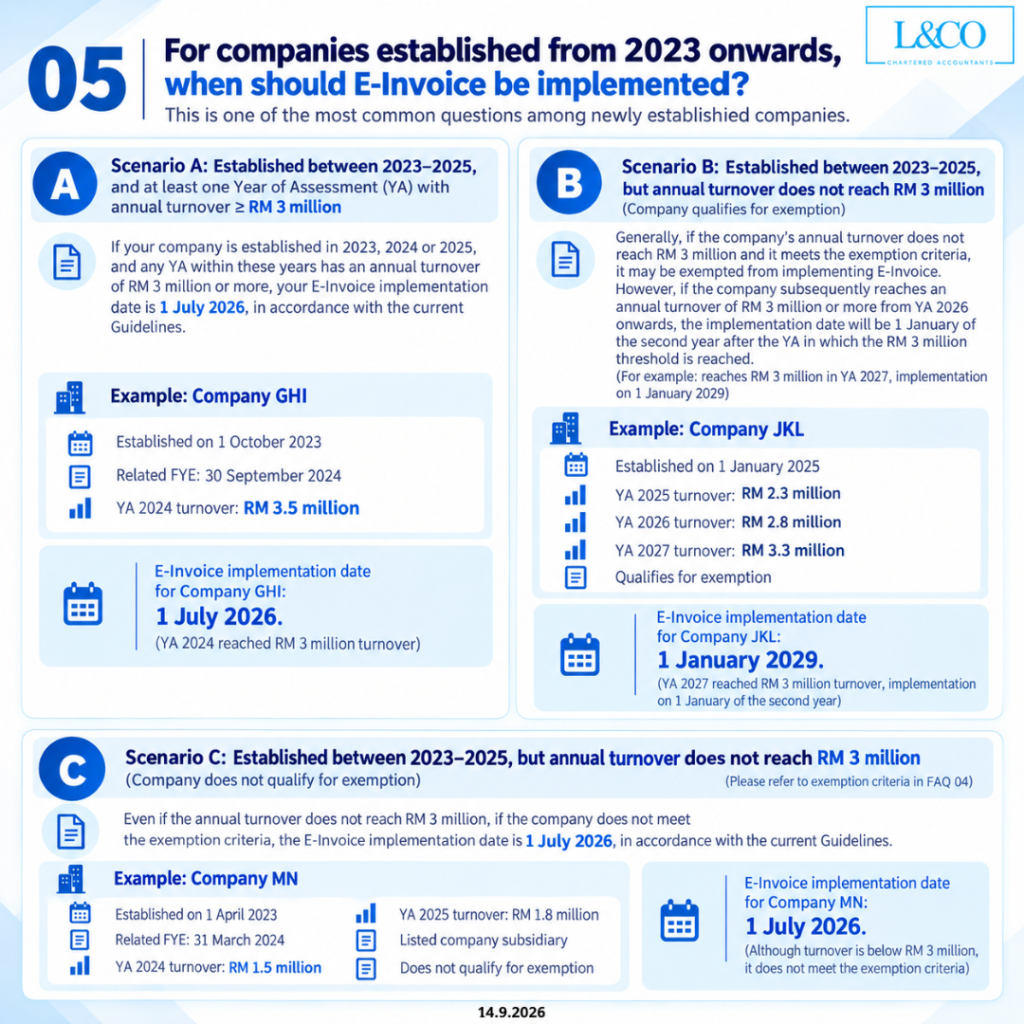
5. What About Companies Established Between 2023 and 2025?
For companies incorporated and commencing business between 2023 and 2025, the applicable E-Invoice implementation date should be determined based on the relevant turnover and exemption rules.
If the company reaches the applicable threshold, it may need to implement E-Invoice according to the prescribed timeline.
If its turnover remains below the relevant threshold and the company satisfies the exemption criteria, it may qualify for exemption.
Newly established companies should therefore avoid simply applying the implementation timeline of older companies without reviewing the rules applicable to their own circumstances.
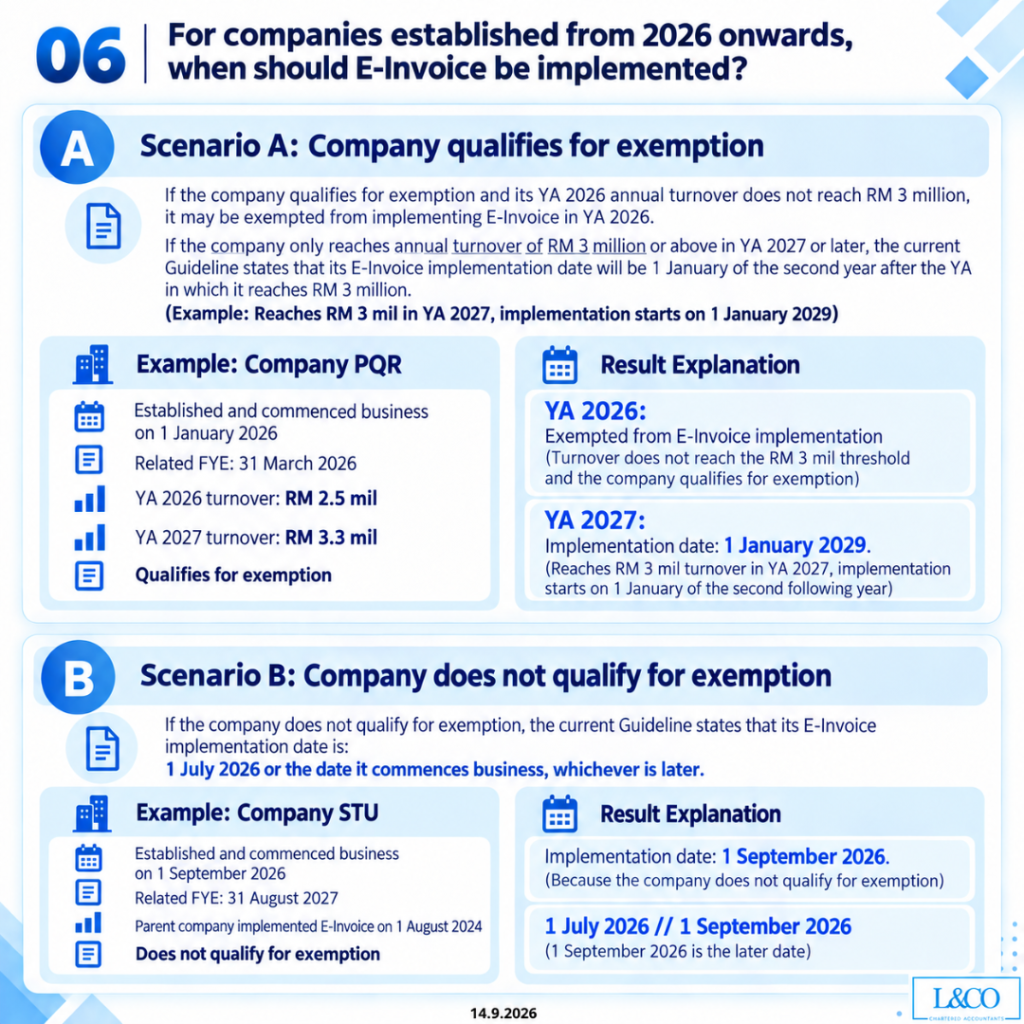
6. What About Companies Established From 2026 Onwards?
Companies established from 2026 onwards should similarly determine whether they satisfy the applicable E-Invoice exemption criteria.
Where a company qualifies for exemption but subsequently reaches the relevant turnover threshold, its E-Invoice implementation date may need to be reassessed based on the applicable rules at that time.
On the other hand, a company that does not qualify for the exemption may be required to implement E-Invoice according to the relevant prescribed implementation timeline.
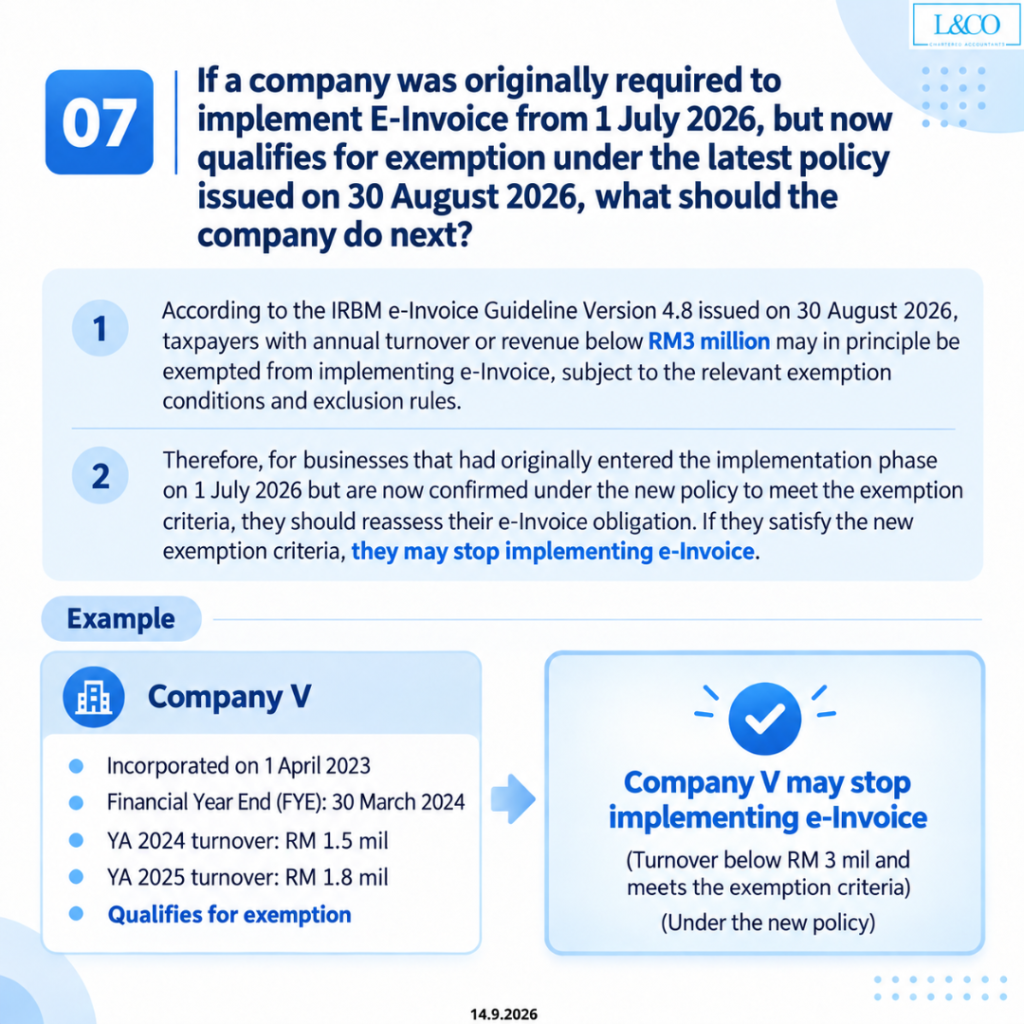
7. Already Implementing E-Invoice but Now Eligible for Exemption — What Should You Do?
Following changes to the E-Invoice exemption threshold, some businesses that had already started implementing E-Invoice may find that they now fall within the expanded exemption category.
However, businesses should not make a decision based only on their turnover.
Before determining the next step, businesses should verify both their Annual Turnover / Revenue and whether they satisfy all applicable exemption criteria.
The company’s overall eligibility should be confirmed before changing its existing E-Invoice process.
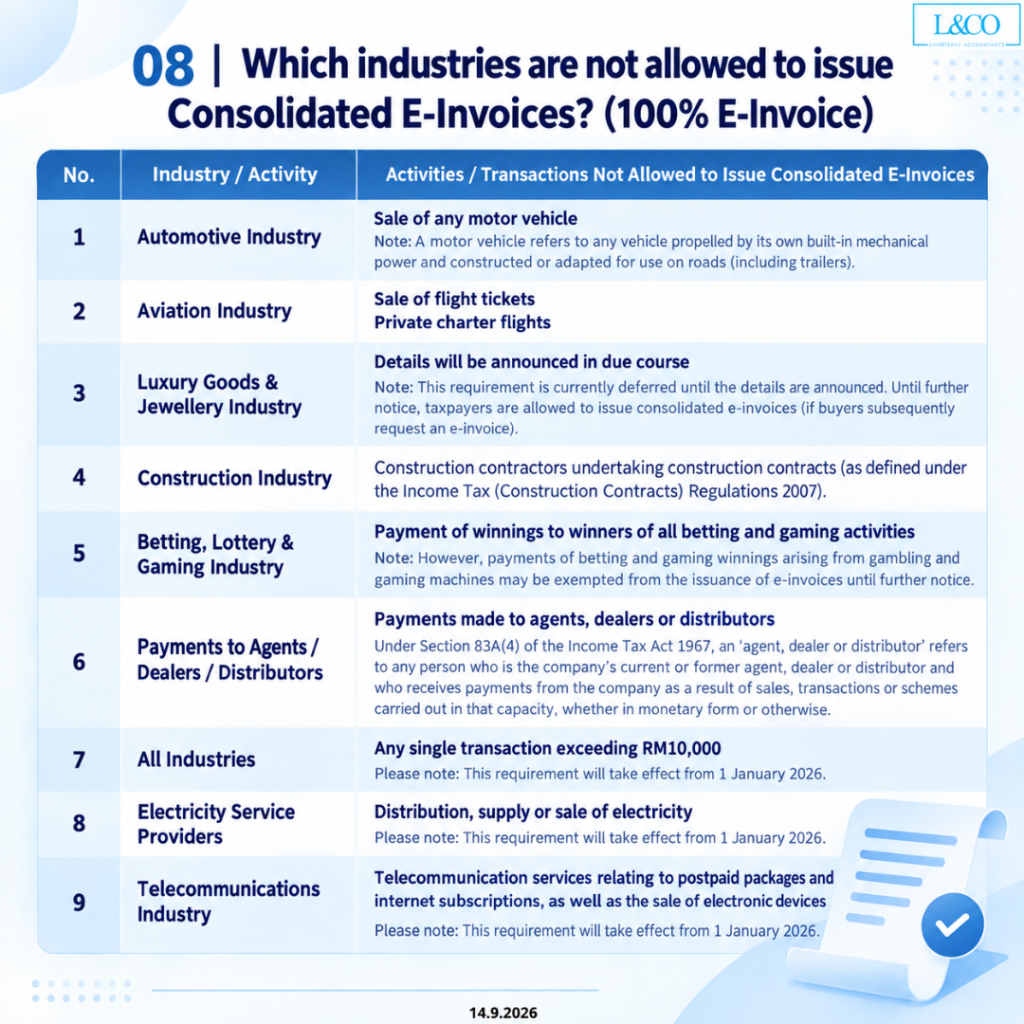
8. Which Transactions Cannot Use Consolidated E-Invoices?
Not every transaction can be included in a Consolidated E-Invoice.
Certain specified activities, industries and transactions may be required to issue individual E-Invoices instead of consolidating multiple transactions into a monthly Consolidated E-Invoice.
Businesses should also pay particular attention to the applicable RM10,000 single-transaction rule.
This is especially important when configuring billing procedures or accounting systems, as businesses need to identify which transactions can be consolidated and which require an individual E-Invoice.
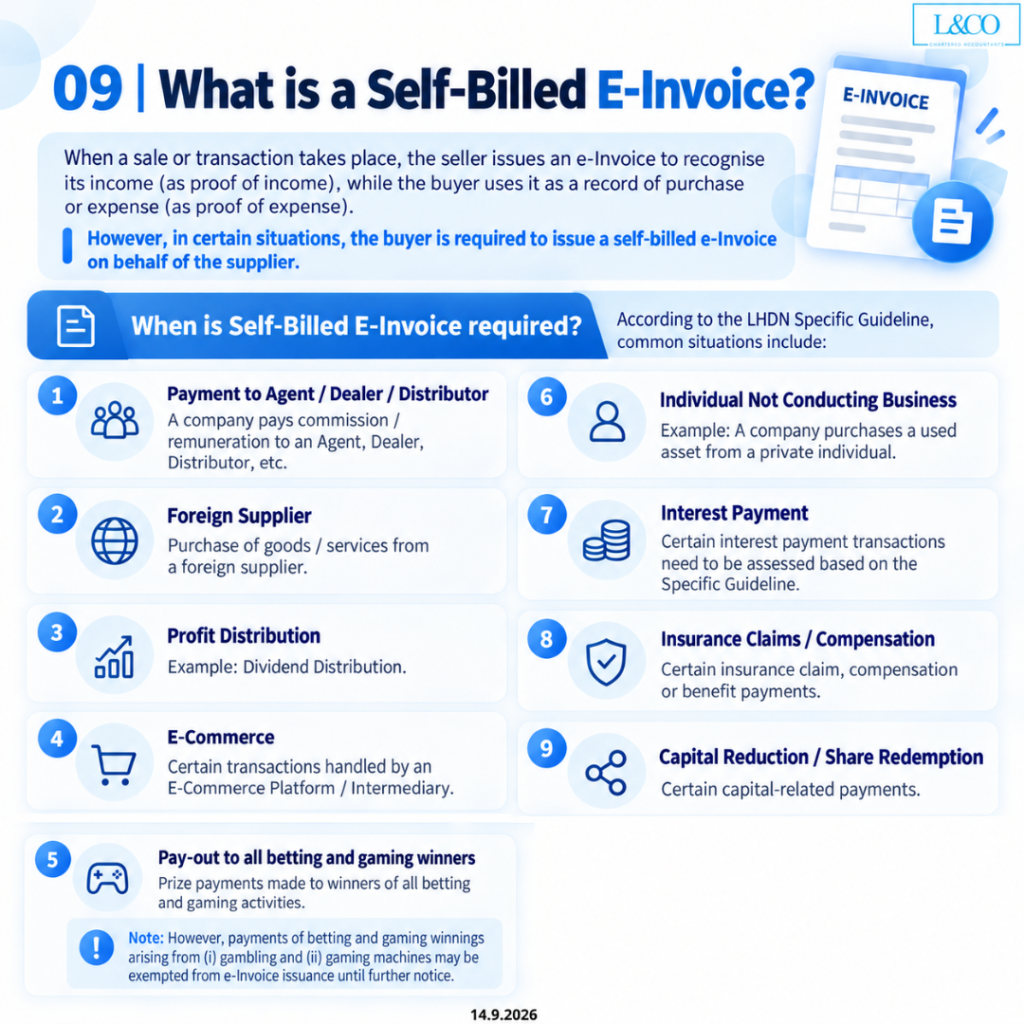
9. What Is a Self-Billed E-Invoice?
Under a normal transaction, the supplier issues the E-Invoice.
However, for certain prescribed transactions, the buyer is required to issue a Self-Billed E-Invoice on behalf of the supplier.
This may arise in certain transactions involving foreign suppliers, agents, dealers, distributors, individuals and other prescribed circumstances.
Businesses should not assume that Self-Billing applies simply because a supplier does not issue an E-Invoice.
The correct treatment should be determined according to the nature of the transaction and the applicable E-Invoice rules
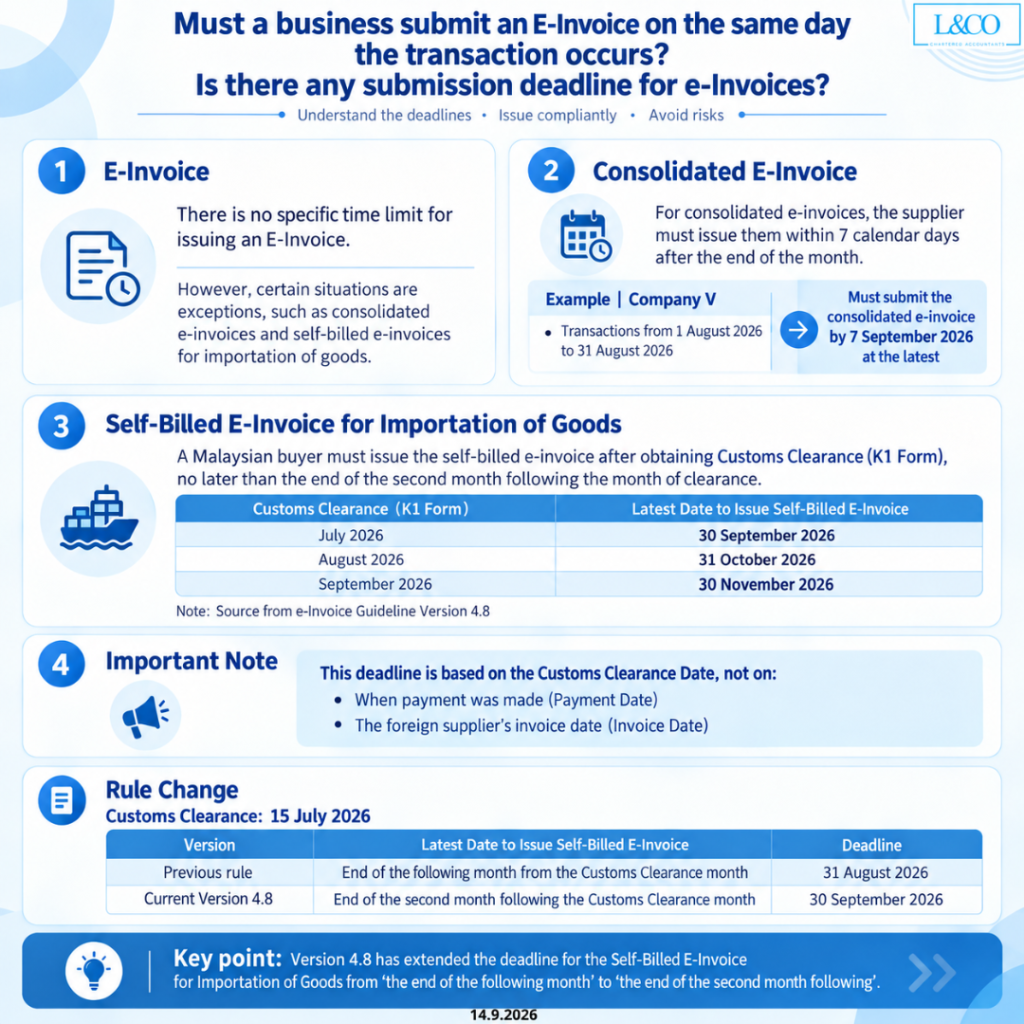
Must Every E-Invoice Be Submitted on the Transaction Date?
Not necessarily.
Different types of E-Invoices may be subject to different timing requirements.
The applicable deadlines for normal E-Invoices, Consolidated E-Invoices and certain Self-Billed E-Invoices may differ.
Businesses dealing with Importation of Goods, Importation of Services and Foreign Income should pay particular attention to which relevant date triggers the applicable deadline, such as the payment date, invoice date, customs clearance date or other prescribed date.
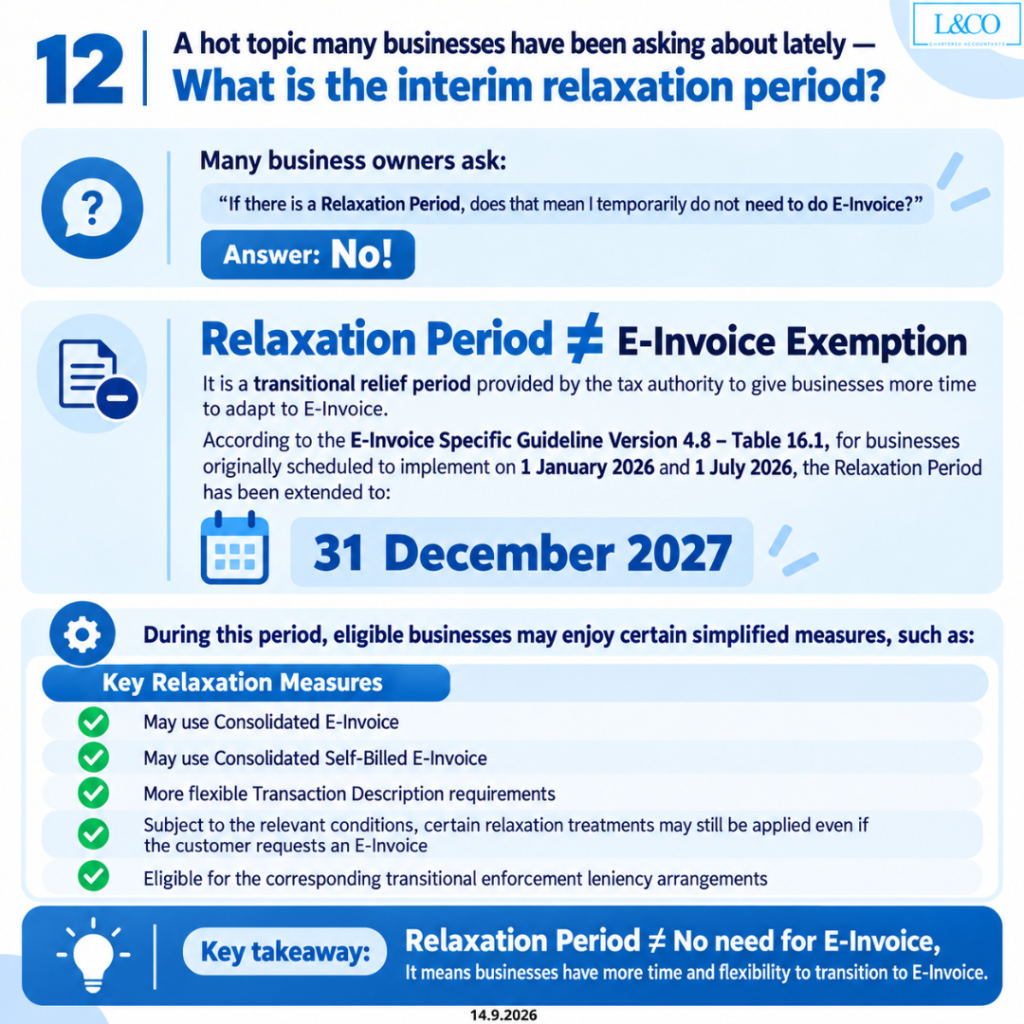
Does the Interim Relaxation Period Mean Businesses Do Not Need to Implement E-Invoice Yet?
No.
An Interim Relaxation Period should not be confused with an E-Invoice exemption.
It is generally intended as a transitional arrangement to provide eligible taxpayers with more flexibility while adapting to the full E-Invoice requirements.
During the applicable relaxation period, certain simplified treatments may be available, but businesses should still understand and comply with the E-Invoice requirements that apply to them.
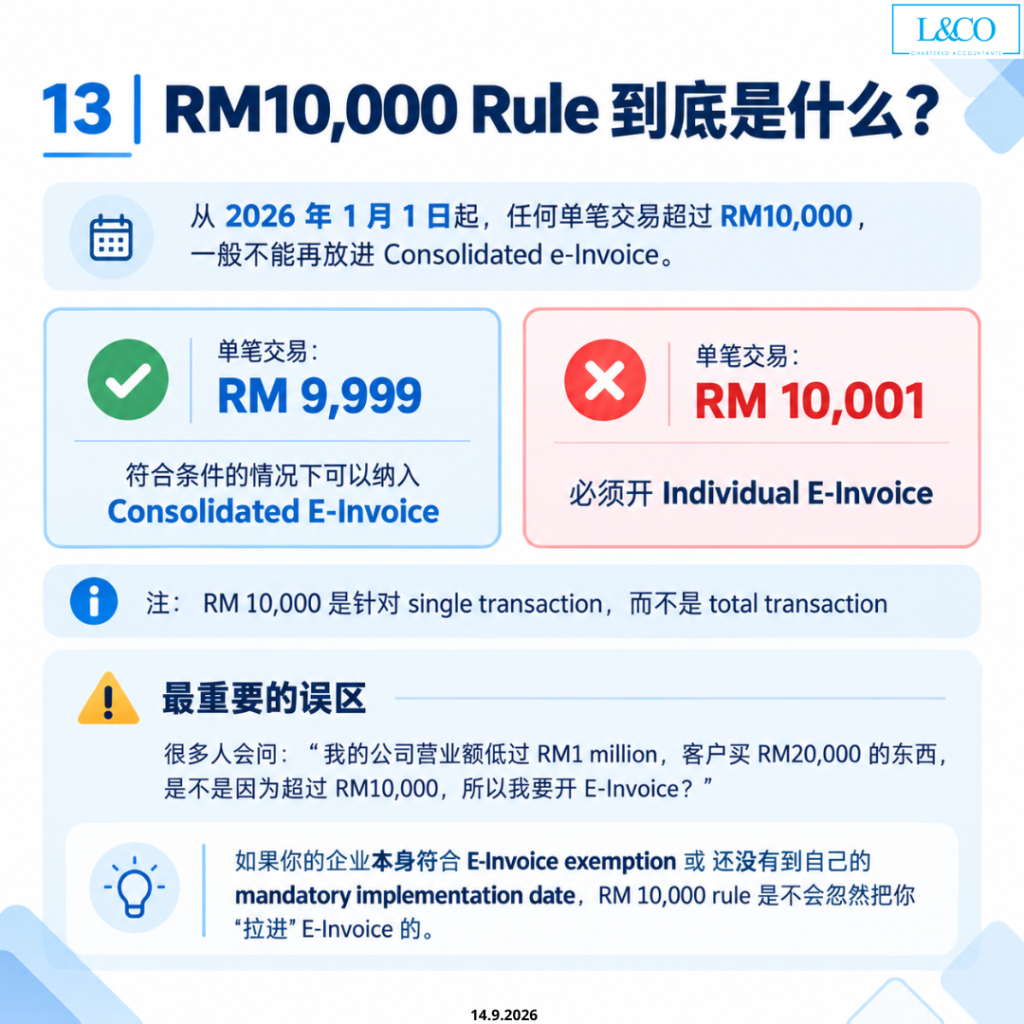
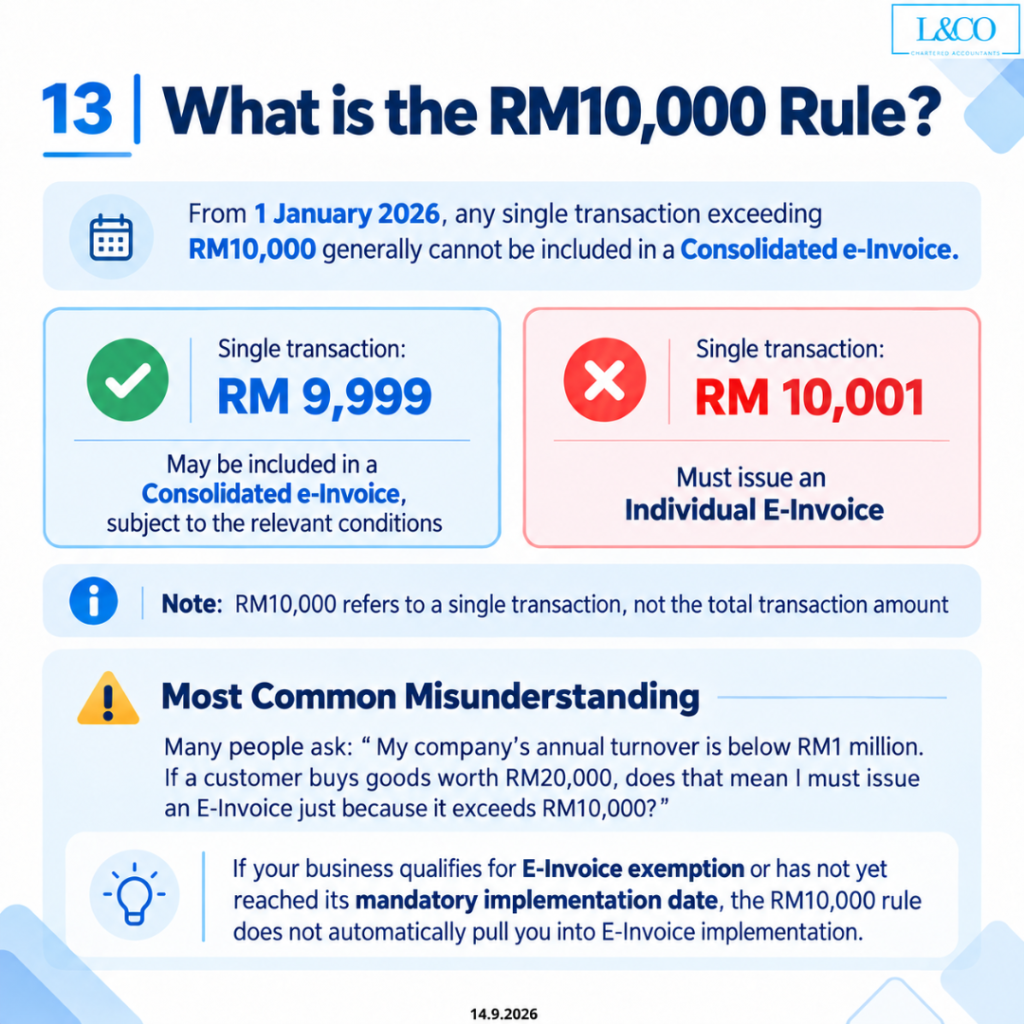
What Is the RM10,000 E-Invoice Rule?
Businesses should pay particular attention to the applicable rules concerning a single transaction exceeding RM10,000.
The RM10,000 amount refers to the value of an individual transaction rather than a company’s total monthly or annual transactions.
However, there is an important distinction:
The RM10,000 rule itself does not automatically bring a taxpayer into mandatory E-Invoice implementation if the taxpayer has not yet reached its mandatory implementation date or otherwise qualifies for an applicable exemption.
Businesses should first determine their own E-Invoice obligation before determining how the individual transaction should be treated.
Do Foreign Workers’ Salaries Require Self-Billed E-Invoices?
Where an individual works under a genuine Employer–Employee relationship and receives employment income through the employer’s payroll, the salary should not simply be treated as a supplier transaction requiring a Self-Billed E-Invoice.
However, the position may differ where the individual is engaged under a Contract for Service, or where workers are supplied through a Manpower Company or Agency.
The key question is therefore not simply whether the worker is Malaysian or foreign.
Businesses should first determine whether the arrangement constitutes an employment relationship or a service arrangement.
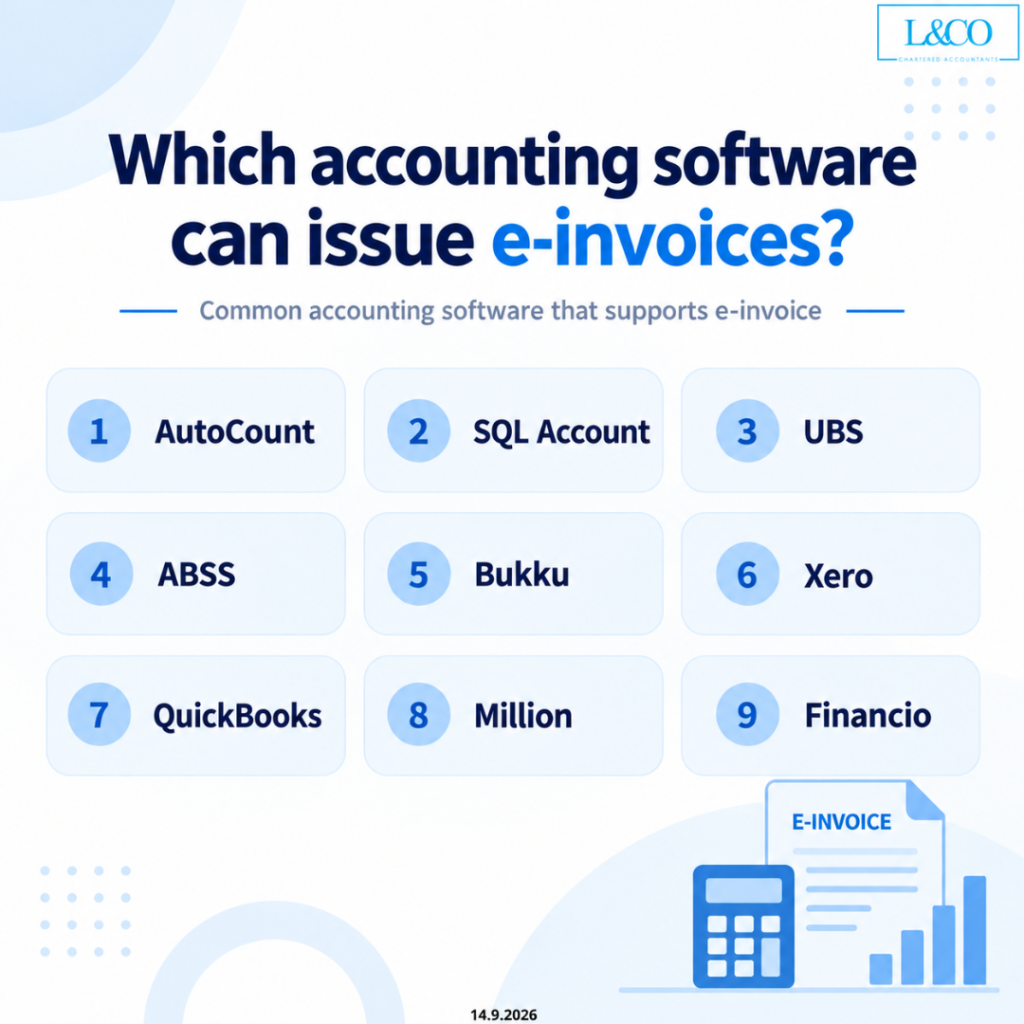
Which Accounting Software Supports E-Invoice?
A growing number of accounting software providers currently offer or are developing Malaysia E-Invoice capabilities, including platforms such as AutoCount, SQL Account, UBS, ABSS, Bukku, Xero, QuickBooks, Million and Financio.
However, businesses should not choose an accounting system based solely on whether it can “issue E-Invoices”.
Other considerations may include its ability to support the company’s actual transaction workflow, MyInvois integration, Consolidated E-Invoices, Self-Billed E-Invoices and overall accounting processes.
The right solution should ultimately fit the business’s operational and compliance requirements.
 (201706002678 & AF 002133)